Rabu, 21 Juni 2023

U.S. Republican hardliners try to force Biden impeachment vote - Reuters

WASHINGTON, June 21 (Reuters) - At least two hardline Republicans plan to try to force the U.S. House to vote on whether to impeach Democratic President Joe Biden and members of his administration, over the objections of Speaker Kevin McCarthy, who fears that such moves risk undermining congressional investigations.

The Republican-controlled House of Representatives is due to vote this week on a resolution to impeach Biden for allegedly violating his oath by failing to enforce immigration laws and to secure the U.S.-Mexico border against the synthetic opioid drug, fentanyl.

"Republicans need to stick together and get this man out office for his dereliction of duty on the Southern Border," the author of the resolution, Representative Lauren Boebert, tweeted on Wednesday.

The efforts stand little chance of advancing in the House, which Republicans control by a narrow 222-212 margin and where multiple Republicans predicted opponents would have the votes to stop the measure from coming to the floor.

Some hardline Republicans have been eager to impeach Biden as an act of retribution after his predecessor, Republican Donald Trump, was twice impeached by the then-Democratic-controlled House, once over Ukraine and once for his actions ahead of the Jan. 6, 2021, assault on the U.S. Capitol.

Senate Republicans in both cases acquitted Trump.

A privileged resolution to censure Democratic Representative Adam Schiff over his leading role in Trump's Ukraine impeachment came before the House for a second time on Wednesday.

Last week, 20 Republicans opposed to the inclusion of a $16 million fine of Schiff joined Democrats in tabling the measure, which was brought by hardline Representative Anna Paulina Luna. But the fine was dropped and a Democratic effort to derail it again failed on Wednesday, setting up an evening vote on passage.

Another hardliner, Representative Marjorie Taylor Greene, said she is planning resolutions to impeach Biden, two members of his Cabinet, FBI Director Christopher Wray and a U.S. attorney who is prosecuting participants in the Capitol attack.

The development means new headaches for McCarthy, two weeks after about a dozen hardliners shut down the House floor to protest his compromise debt-ceiling deal with Biden.

McCarthy said he opposed a one-off vote to impeach Biden while committee investigations into the president's family business dealings and his administration are still under way.

"Throwing something on the floor actually harms the investigation that we're doing right now," McCarthy told reporters. "(It) isn't fair to the American public without making the case and making the argument."

White House spokesperson Ian Sams on Twitter dismissed the proposals as "baseless political stunts."

Greene, who has already introduced formal articles of impeachment against Biden and the other officials, told reporters that internal division is preventing Republicans from approving impeachment bills in the House Judiciary Committee.

Boebert introduced her proposal as a so-called privileged resolution, subject to a vote within two legislative days, and Greene said she would consider a similar move.

"I'm converting them to privileged to use when I feel it's necessary," Greene said of her impeachment bills against Biden, Wray, Attorney General Merrick Garland, Homeland Security Secretary Alejandro Mayorkas and U.S. Attorney Matthew Graves.

Greene was one of the few Republicans who voiced open support for Boebert's impeachment resolution.

Reporting by David Morgan; Editing by Scott Malone and Jonathan Oatis

Our Standards: The Thomson Reuters Trust Principles.

Adblock test (Why?)


from U.S. - Latest - Google News https://ift.tt/4IZMcgD
via IFTTT

Majorjon Kaylor charged in deaths of 4 Idaho neighbors as "horrific" details emerge - CBS News

New details are emerging about a previous dispute between neighbors after prosecutors say a northern Idaho man went to his neighbor's home and shot and killed four family members there, including two teenagers.

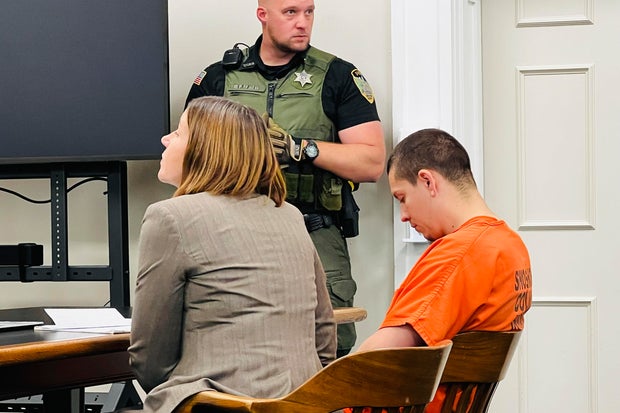
Majorjon Kaylor, 31, of Kellogg, was arrested Sunday night shortly after the shooting in the small mining community. Shoshone County Sheriff Holly Lindsey confirmed to CBS News that Kaylor was charged with murder and was being held in Shoshone County jail. 

Killed were Kenneth Guardipee, 65; his daughter Kenna Guardipee, 41; and her sons 18-year-old Devin Smith and 16-year-old Aiken Smith. The family lived in the same multi-home building as Kaylor and they had recently moved into the apartment, CBS affiliate KREM-TV reported. 

Idaho Fatal Shooting
Majorjon Kaylor, 31, right, sits next to defense attorney Lisa Chesebro in a Wallace, Idaho, courtroom on Tuesday, June 20, 2023, during his first appearance on four murder charges. Prosecutors say Kaylor shot and killed his neighbors, including a child, Sunday evening.  Josh McDonald / AP

If convicted, Kaylor could face the death penalty. He is being held without bond and has not yet entered a plea.

Few details have been released about the shooting, and authorities have not said what they believe Kaylor's motive may have been.

But there had been a recent conflict between the families, police said: A week before the shootings, Kaylor's family called police to complain that 18-year-old Devin Smith was standing in front of his bedroom window, masturbating in view of Kaylor's young daughters who were playing outside. Smith's family lived in the bottom unit of the duplex, and Kaylor's family lived in the top unit.

"We responded to the call, investigated the call, and the report was done that day and submitted to the prosecutor's office for charges," Kellogg Police Chief Paul Twidt said. "I stand by what my officer did, and he did everything he could at the time. Nobody could have foreseen anything like this."

The police department recommended that Smith be charged with indecent exposure, a misdemeanor, Twidt said, and the prosecutor's office told the officer the charge would be filed. There was no record of the charge in the online court system on Tuesday, however, which could mean that Smith had not yet been served with the formal charges before he died, or that the case had not yet been made public for another reason.

During Kaylor's initial court appearance, prosecuting attorney Benjamin Allen said the crime was "relatively horrific" and noted that one of the victims was a child. He also said Kaylor admitted the killings when he was interviewed by police.

"Admissions were ultimately made to the offenses charged," Allen told Shoshone County Magistrate Judge Keisha Oxendine during Tuesday's court proceeding.

"We see a crime which was committed in a relatively horrific manner in regards to the nature of the allegations, the manner in which it was carried out, and the method in which was utilized by the defendant in the course of his actions," Allen said.

Citing the criminal complaint, KREM-TV reported that when police arrived at the scene, Kaylor reportedly said he "snapped," "lost it" and "did something about it." 

Police obtained video surveillance that captured the altercation and gunshots, the station reported.

The Shoshone County dispatch center received a 911 call around 7:20 p.m. Sunday indicating that multiple people had been killed. Law enforcement officers found four people dead of gunshot wounds, and they detained Kaylor.

"This is a tragic situation that will affect the Kellogg community. Detectives continue working to establish a timeline and what led to the shooting," Lt. Paul Berger, a detective with the Idaho State Police, said in a news release on Monday.

The charging documents allege the shootings of the two oldest victims were "premeditated and/or to execute vengeance." The other killings were allegedly, "premeditated, to executive vengeance, and/or committed in the perpetration of burglary," according to the charging documents. Under Idaho law, it is considered burglary to enter a house, room or apartment with the intent to commit a felony such as murder.

A GoFundMe to raise money for funeral expenses for the family has raised more than $3,600.

A preliminary hearing in the case has been set for July 3.

The quadruple homicide comes just seven months after another multiple killing in the state made national headlines. Bryan Kohberger, 28, was charged with four counts of murder in connection with the stabbing deaths of four University of Idaho students who were found dead on Nov. 13 at a home in Moscow, Idaho. 

The latest killings in Idaho came amid a spate of gun violence over the weekend that killed and wounded numerous people across the U.S., including at least 60 shot in the Chicago area alone.

Adblock test (Why?)


from U.S. - Latest - Google News https://ift.tt/5lcYsuE
via IFTTT

Senin, 19 Juni 2023

Titanic tourist submersible goes missing with search under way - BBC

Reuters

A submersible used to take people to view the wreck of the Titanic has gone missing in the Atlantic Ocean.

The Boston Coastguard told BBC News that a search and rescue operation was under way off the coast of Newfoundland.

It is unclear how many people were on board when it went missing.

Small submersibles occasionally take paying tourists and experts to view the wreck of the Titanic, some 3,800m (12,500ft) beneath the ocean surface.

OceanGate Expeditions, a private company that organises deep sea expeditions, confirmed in a statement that it owned the missing submersible and people were on board.

"We are exploring and mobilising all options to bring the crew back safely," it said on Monday. "Our entire focus is on the crewmembers in the submersible and their families."

"We are working toward the safe return of the crewmembers," it added.

The company charges guests $250,000 (£195,270) for a place on its eight-day expedition to see the famous wreck.

It bills the trip on its carbon-fibre submersible as a "chance to step outside of everyday life and discover something truly extraordinary".

According to its website, one expedition is ongoing and two more have been planned for June 2024.

The submersible can seat five people, the company says, which usually includes a pilot, three paying guests, and what it calls an "content expert".

A full dive to the wreck, including the decent and ascent, reportedly takes eight hours in total.

The Titanic sits 3,800m (12,500ft) beneath the surface at the bottom of the Atlantic. It is about 600km (370 miles) off the coast of Newfoundland, Canada.

The passenger liner, which was the largest ship of its time, hit an iceberg on its maiden voyage from Southampton to New York in 1912. Of the 2,200 passengers and crew onboard, more than 1,500 died.

The Titanic has been extensively explored since the wreck was discovered in 1985.

It lies in two parts, with the bow and the stern separated by about 800m (2,600ft). A huge debris field surrounds the broken vessel.

Last month, the first full-sized digital scan of the wreck was created using deep-sea mapping. The scan shows both the scale of the ship, as well as some minute details, such as the serial number on one of the propellers.

Adblock test (Why?)


from U.S. - Latest - Google News https://ift.tt/65pHWh8
via IFTTT

Minggu, 18 Juni 2023

At least 1 juvenile killed and 9 others injured in an overnight shooting in St. Louis - CNN

CNN  — 

At least one juvenile was killed and nine others injured on Sunday in an overnight shooting in downtown St. Louis, according to Mayor Tishaura Jones.

The shooting took place downtown just after 1 a.m. CT, inside a building at 14th and Washington where a party was being held. The space usually serves as an office space.

A 17-year-old suspect is in custody, police Chief Robert Tracy said during a news conference Sunday.

“This Father’s Day, families across the St. Louis region woke to the news of yet another mass shooting,” Jones said.

“It’s every parent’s worst nightmare, tenfold,” Jones said. “My heart goes out to all of the families in pain today. All those attending will carry with them the scars, physical and mental, from the gun violence that tore into their lives.”

The victim who died was a 17-year-old male, according to Tracy.

The injured victims’ ages range between 15 and 19 years old, the chief said. A 17-year-old female was also trampled running from the scene and has serious spinal injuries, he added.

Police recovered multiple firearms from the scene, including an AR-15 style rifle and a handgun, Tracy said.

Police are investigating who had authority over the office building and who was responsible for the party.

“Wrap your arms around your children today as we mourn because I will wrap my arms around mine,” Jones said.

Missouri has one of the highest rates of gun deaths in the US, according to a 2022 study by Everytown for Gun Safety.

Adblock test (Why?)


from U.S. - Latest - Google News https://ift.tt/NPaK8iz
via IFTTT

Sabtu, 17 Juni 2023

Biden's rally with union workers marks first big event of his 2024 campaign - The Associated Press

PHILADELPHIA (AP) — President Joe Biden is promoting his pro-labor record Saturday at his first major political rally of his reelection campaign, appearing before exuberant union members to make the case that his economic agenda is boosting the middle class.

He plans to “lay out the core principles of his economic message” during his remarks at the Philadelphia Convention Center, according to his campaign. He also intends to talk about how a sweeping climate, tax and health care package he signed into law last year has cut the cost of prescription drugs and lowered insurance premiums. It’s part of his administration’s focus on his achievements during his first two years in office — the centerpiece argument for a second term.

Hundreds of union workers standing inside the convention hall began chanting “Let’s go, Joe!” and blowing whistles and hoisting campaign signs hours before Biden arrived. In the meantime, members of unions representing professions from carpenters to airport service workers to entertainers to heavy service equipment engineers praised Biden from the stage — some speaking in Spanish with translators.

The event, which organizers said included unions representing 18 million workers nationwide, recalled then-candidate Biden opening his 2020 presidential campaign at a union hall in Pittsburgh.

That underscores just how important labor support will be to his winning a second term. The president told reporters before he left Washington that he had met with business leaders on Friday and that corporate interests and “unions are beginning to work together.”

“I’m excited about this is the beginning of something big,” Biden said, “and we’ll begin changing the economic balance.”

Several of the nation’s most powerful unions — including the AFL-CIO, American Federation of Teachers and the American Federation of State, County and Municipal Employees — officially endorsed Biden’s campaign on Friday. The first-of-its-kind joint endorsement among the unions and the backdrop of hundreds of workers are part of a meticulously choreographed effort to show the support of labor behind what Biden himself calls the most pro-union president in history.

“I’m saying that my philosophy about building from the middle out and the bottom up is working,” Biden told reporters before a fundraiser in Connecticut on Friday evening.

The Philadelphia event also comes amid some encouraging economic news for Biden, with inflation cooling last month, continuing a steady decline in consumer prices primarily driven by lower gas prices, a smaller rise in grocery costs than in previous months and less expensive furniture, air fares and appliances.

The city and Pennsylvania have long been at the heart of Biden’s political efforts. Philadelphia was the site of his campaign headquarters in 2020 and the state was one of a handful that had voted for Donald Trump in 2016 but flipped back to Democrats four years later.

Until now, Biden’s primary campaign activity has been fundraising as the campaign tries to amass an impressive fundraising haul before the year’s second quarter concludes at the end of the month. The president raised money at a private home in Greenwich, Connecticut, on Friday and soon will hold fundraisers in California, Maryland, Illinois and New York.

Before addressing the union gathering, Biden took a helicopter tour over the collapsed section of Interstate 95 in Philadelphia that has complicated traffic along one of the nation’s most crowded highways.

Michael Smith, a 62-year-old retired electrician who was attending Saturday’s rally in a T-shirt bearing the name and logo of the International Brotherhood of Electrical Workers, said he liked Biden’s chances of reelection next year because of his administration’s championing green jobs and construction nationwide as part of the bipartisan infrastructure law Biden signed in 2021.

“You can see see how important that is with 95 going down,” Smith said of the legislation, adding “That is a big factor in creating work and jobs. Not just for unions but for the middle class.”

Another union member on hand, 53-year-old Jennifer McKinnon, a grade school librarian and member of the National Education Association, said she felt that Biden had a personal commitment to education because his wife, Jill, was a teacher who continued to teach English at a Northern Virginia community college as first lady.

“I’m very optimistic. I fear that the Republicans are going to get caught in their cycle that they did last time and people aren’t going to buy it this time, so Joe’s going to sweep right in,” McKinnon said of the 2024 election, alluding to Donald Trump, who is the early front-runner for the Republican presidential nomination.

Many in the crowd also said they thought the criminals cases in federal and New York courts against Trump could complicate his electoral pitch even though his message of economic populism resonated with some union members in the past. AP VoteCast, a sweeping survey of the 2020 electorate, found that about 6 in 10 self-identified union members supported Biden, a margin that outpaced Trump but was not commanding.

Randi Weingarten, president of the American Federation of Teachers, said part of the reason the AFT and other top unions endorsed Biden nearly 18 months before Election Day 2024 was to promote Biden’s economic record against Republican-championed cultural issues.

Clark Hamilton, a 63-year-old retired electrician said that Biden represents union values but noted that the president also sometimes “plays it like most politicians, in the middle.” He referenced Biden urging Congress to helped prevent a rail strike last year, which the president said could cripple commerce nationwide.

“That’s a shame,” Hamilton said. “But he was trying to save the economy.”

Still, Hamilton said he’s confident that Biden’s record will secure him a second term net year “especially if it’s against Trump.”

Adblock test (Why?)


from U.S. - Latest - Google News https://ift.tt/rYjuX3F
via IFTTT

Kamis, 15 Juni 2023

Supreme Court rejects challenges to law that governs tribal adoptions - CNN

Washington CNN  — 

The Supreme Court on Thursday left intact a decades-old law that prioritizes the placement of Native American children with Native families or tribes in child custody proceedings, rejecting challenges brought by several adoptive parents.

The law was passed in 1978 to protect tribal sovereignty after Congress documented the alarmingly high number of children with Native American ancestry being placed with non-Native families or institutions in state child welfare and private adoption proceedings.

The 7-2 decision backs the law passed in the wake of decades of hostility on the part of the federal government when it comes to child custody issues and traditional values of Indian tribes.

Justice Amy Coney Barrett, writing for the majority, said Congress did not exceed its authority in passing the law.

“In a long line of cases we have characterized Congress’ power to legislate with respect to the Indian tribes as plenary and exclusive,” she wrote.

“Congress’s power to legislate with respect to Indians is well established and broad,” Barrett wrote, but acknowledged that the court’s precedent in the area has been “unwieldy.”

She noted that in general, Congress lacks a general power over domestic relations, but that the Constitution does not erect a “firewall around family law.”

She was joined by Chief Justice John Roberts, and Justices Sonia Sotomayor, Elena Kagan, Neil Gorsuch, Brett Kavanaugh and Ketanji Brown Jackson.

The case pitted the interest of Native American tribes, who said their existence as sovereign nations was on the line, against non-Native couples seeking to foster or adopt children with Native ancestry.

The opinion, which is a defeat for the couples who challenged the law, upheld a lower court’s ruling that the law is consistent with Congress’ authority.

President Joe Biden praised Thursday’s decision.

“Today’s decision from the Supreme Court keeps in place a vital protection for tribal sovereignty and Native children,” Biden said in a statement.

“Our Nation’s painful history looms large over today’s decision,” Biden added. “In the not-so-distant past, Native children were stolen from the arms of the people who loved them. They were sent to boarding schools or to be raised by non-Indian families – all with the aim of erasing who they are as Native people and tribal citizens. These were acts of unspeakable cruelty that affected generations of Native children and threatened the very survival of Tribal Nations. The Indian Child Welfare Act was our Nation’s promise: never again.”

Gorsuch: ‘Our Constitution reserves for the Tribes a place … in the structure of American life’

Gorsuch, who was largely raised in the West, often sides with Indian tribes in disputes that reach the high court. On Thursday, he wrote an opinion concurring with the majority to underline the importance of the law to the tribes, a ringing endorsement of tribal sovereignty.

“Often, Native American Tribes have come to this Court seeking justice only to leave with bowed heads and empty hands,” Gorsuch wrote. “But that is not because this Court has no justice to offer them.”

“Our Constitution reserves for the Tribes a place – an enduring place – in the structure of American life,” he said, adding that it “promises them sovereignty for as long as they wish to keep it.”

“In adopting the Indian Child Welfare Act, Congress exercised that lawful authority to secure the right of Indian parents to raise their families as they please; the right of Indian children to grow in their culture; and the right of Indian communities to resist fading into the twilight of history,” he said.

A coalition of the tribes that defended the law praised the majority decision on Thursday, saying in a statement that it’s “a major victory for Native tribes, children, and the future of our culture and heritage.”

“It is also a broad affirmation of the rule of law, and of the basic constitutional principles surrounding relationships between Congress and tribal nations,” the tribes said. “We hope this decision will lay to rest the political attacks aimed at diminishing tribal sovereignty and creating instability throughout Indian law that have persisted for too long.”

Thomas and Alito dissent

Conservative Justices Clarence Thomas and Samuel Alito dissented in the case but did not join each other’s opinions.

Thomas took issue with the federal government’s attempt to regulate child welfare proceedings normally left to state courts. He said the law “ignored the normal limits on the Federal Government’s power and prescribed rules to regulate state child custody proceedings in one circumstance: when the child involved happens to be an Indian.”

“When Congress has so clearly intruded upon a longstanding domain of exclusive state powers, we must ask not whether a constitutional provision prohibits that intrusion, but whether a constitutional provision authorizes it,” he said. He called the majority’s justifications a “smorgasbord of constitutional hooks” and said “not one of them works.”

Alito concerned himself with the actual welfare of the children seeking new homes. He said that decisions about child custody, foster care and adoption proceedings are “core state functions” and that the “primary concern” should be the best interests of the child. He zeroed in on one adoptive family seeking to adopt a child with Native heritage that has lived with the couple for over a year. He noted that the child has developed a strong bond with the family, but the adoption was initially blocked even though the child’s biological parents, his grandmother, court-appointed guardians and a psychological expert all supported it.

He said that while he was “sympathetic” to the challenges that tribes face in maintaining members and preserving their cultures, “the Constitution does not permit Congress to displace long-exercised state authority over child custody proceedings to advance those interests at the expense of vulnerable children and their families.”

Law was meant to correct past government abuses

The Indian Child Welfare Act was enacted as a response to serious harms caused by widespread child welfare practices that resulted in the separation of Indian families, and adoption or foster placement in non-Indian homes.

It was passed in part to rectify past government programs that resulted in abuse and the breakup of Indian families and applies to children living off-reservation who are involved in custody disputes in state courts. A provision of the law requires any party seeking an Indian child’s removal from the tribe to give notice to the child’s parent (or custodian) or tribe. It establishes standards for the placement of Indian children in foster homes that require a preference be given “absence of good cause to the contrary” with a member of the child’s extended family, other members of the child’s tribe or other Indian families.

A lawyer for the private individuals had argued that the law discriminated on the basis of race in violation of the Constitution and does not serve the best interest of the child.

Barrett focused her opinion on whether Congress exceeded its authority in passing the law. She dismissed an Equal Protection challenge to the placement preferences, holding that the families seeking to adopt did not have the “standing,” or legal authority, to bring those challenges because they could not show a close enough nexus between their alleged injury and the federal officials’ whose enforcement of the statute they were seeking to block.

In addition, Texas had sought to challenge the preferences arguing that they interfered with state adoption proceedings. But Barrett said the state couldn’t sue on behalf of its citizens in this instance. “Were it otherwise, a State would always have standing to bring constitutional challenges when it is complicit in enforcing federal law,” she said.

Matthew D. McGill, a lawyer for the private individuals, had stressed that the law deprives Indian children – some 11,000 who were in foster care in 2020 – of an adoption that could be in the child’s best interest. He challenged the law on a variety of grounds, arguing that Congress lacked the authority to pass the law because its powers relating to Indian affairs has limitations. He said the law violates the Constitution’s Equal Protection Clause because any classification by race has to survive strict scrutiny in the courts.

McGill had the support of Texas Solicitor General Judd E. Stone II, who told the justices that “Congress cannot require states to administer a nationwide child custody regime” and said that the law can, at times, return children to unsafe environments, and contributes to high statistics concerning Indian child welfare. He pushed back on any notion that the state does not have the legal injury necessary to bring the case by arguing that if a state fails to comply with the law it could lose substantial amounts of Medicare payments.

McGill said Thursday that a “main concern” was for a 5-year-old girl of Native heritage – known in court papers as “Y. R. J.” – who has lived with the named plaintiff, the Brackeen family, “for nearly her whole life.”

He continued: “The Court did not address our core claim that ICWA impermissibly discriminates against Native American children and families that wish to adopt them, saying it must be brought in state court. As Justice Kavanaugh observed today, that equal protection claim is ‘serious,’ and we will ask the state court to address it in the Brackeens’ upcoming trial to adopt Y.R.J.”

Twenty-five states – home to 86% of federally recognized Indian tribes – filed a friend-of-the-court brief in favor of the law. “As state sovereigns,” they argued in briefs, “we also have a powerful interest in mutually beneficial relationships with Indian tribes in our states – who share our interest in the wellbeing of Indian children.”

Challengers to the law won at the district court level. A federal appeals court reversed the decision, but agreed to hear the case with a larger number of judges. That court issued a fractured opinion striking part of the law.

Ian H. Gershengorn, a lawyer for the tribes, had defended the law by reiterating to the Supreme Court that Congress has “plenary power” over Native Americans.

“Since the founding, the health and safety of Indian children has been the province of the federal government and tribes, not the states,” he told the justices.

“Congress enacted ICWA because Indian children were being torn from their families and tribes through the operation of state family law in state courts,” Gershengorn said.

This story has been updated with additional developments.

Adblock test (Why?)


from U.S. - Latest - Google News https://ift.tt/vHO2azR
via IFTTT

Supreme Court Upholds Native American Adoption Law - The New York Times

At issue in the case was whether a law aimed at keeping Native American adoptees within tribes is constitutional.

The Supreme Court on Thursday upheld a 1978 law aimed at keeping Native American adoptees with their tribes and traditions, handing a victory to tribes that had argued that a blow to the law would upend the basic principles that have allowed them to govern themselves.

Justice Amy Coney Barrett wrote the majority opinion. She was joined by six other justices. Justices Clarence Thomas and Samuel A. Alito Jr., dissented.

Justice Barrett acknowledged the myriad thorny subjects raised in the challenge to the law, which pitted a white foster couple from Texas against five tribes and the Interior Department as they battled over the adoption of a Native American child.

“The issues are complicated,” she wrote. “But the bottom line is that we reject all of petitioners’ challenges to the statute, some on the merits and others for lack of standing.”

Under federal law, preference is given to Native families, a policy that the couple said violated equal protection principles and discriminated against Native children and non-Native families who wanted to adopt them because it hinges on placement based on race.

The tribes have said that they are political entities, not racial groups, and that doing away with that distinction, which underpins tribal rights, could imperil nearly every aspect of Indian law and policy, including measures that govern access to land, water and gambling.

The 1978 legislation, the Indian Child Welfare Act, was meant to address the legacy of abuses of Native American children, hundreds of thousands of whom had been separated from their tribes to be raised by families with no connection to their culture.

Typically, when it comes to a child’s welfare, a judge is charged with determining the best interest of the child. Under the act, however, Native American children are subject to different rules, in part to safeguard their tribal ties.

The law lays out priorities for adoption before a child can be placed with a non-Native family. Children should first be in the care of a member of their extended family. If that is not possible, then priority would move to a member of their tribe; failing that, children should go to “other Indian families.”

An evangelical couple from Texas, Jennifer and Chad Brackeen, along with other families, challenged the law after they took in a boy known in court records as A.L.M. The boy was less than a year old in 2016, when he entered the foster care system in the state. The boy, born to a Navajo mother and a Cherokee father, joined the couple after Navajo tribal placements fell through and eventually, both tribes agreed to let the couple adopt the child.

Their faith, the Brackeens have said, along with their comfortable living circumstances, called them to become foster parents.

In 2018, Judge Reed O’Connor of the United States District Court for the Northern District of Texas struck down the law as unconstitutional.

That same year, A.L.M.’s mother gave birth to another child, a girl. She, too, entered foster care. The Brackeens filed for custody, hoping she could join her brother. The Navajo sought to have the child placed with her great-aunt, who lives on a reservation.

A state judge determined that the Brackeens would share custody with the great-aunt, with the girl spending time with her extended family each summer on the reservation.

Both the tribe and the couple appealed the decision as A.L.M.’s case wound its way through the U.S. Court of Appeals for the Fifth Circuit.

The court largely upheld the law, prompting both sides to seek Supreme Court review.

The Supreme Court has heard other challenges to the Indian Child Welfare Act, most recently in 2013, but the court’s composition has shifted considerably since then.

Other states, including Ohio and Oklahoma, have backed the Brackeens, arguing that the law intrudes on states’ ability to handle child welfare cases. The Goldwater Institute, a conservative policy center in Arizona, claimed the legislation interferes with the duty of states to protect abused and neglected children by improperly forcing state agencies to carry out a federal program.

Medical groups, including the American Academy of Pediatrics, have weighed in to support the legislation, arguing that it is an important tool to help redress “the intergenerational pain of lost connections and the trauma of historical loss.”

In wide-ranging arguments in November, the justices focused on whether Congress had the power to enact the legislation in the first place and whether it violated equal protection principles.

In particular, they considered the provision that allowed Native children to be placed with “other Indian families” — and whether that was a determination based on race.

Justice Brett M. Kavanaugh had appeared skeptical of the law. Offering an analogy, he said the court would not sustain a similar measure were it applied to white or Latino families. He said he did not think the court would ever allow “Congress to say that white parents should get a preference for white children in adoption or that Latino parents should get a preference for Latino children in adoption proceedings.”

The court’s three liberal members, along with Justice Neil M. Gorsuch, who has gained a reputation as a tribal rights advocate, had seemed supportive of the law.

Justice Ketanji Brown Jackson said that Congress had the authority to regulate adoption of Native children, as the tribes had argued.

“Congress said things like there’s no resource that is more vital to the continued existence and integrity of Indian tribes than their children,” she said. “They constantly cast regulations regarding children, Indian children, as a matter of tribal integrity, self-governance, existence.”

Adblock test (Why?)


from U.S. - Latest - Google News https://ift.tt/EFsYK5a
via IFTTT

Three-quarters of Americans think Trump isn’t focusing on top US issues – poll - The Guardian

[unable to retrieve full-text content] Three-quarters of Americans think Trump isn’t focusing on top US issues – poll    The Guardian Trump’...