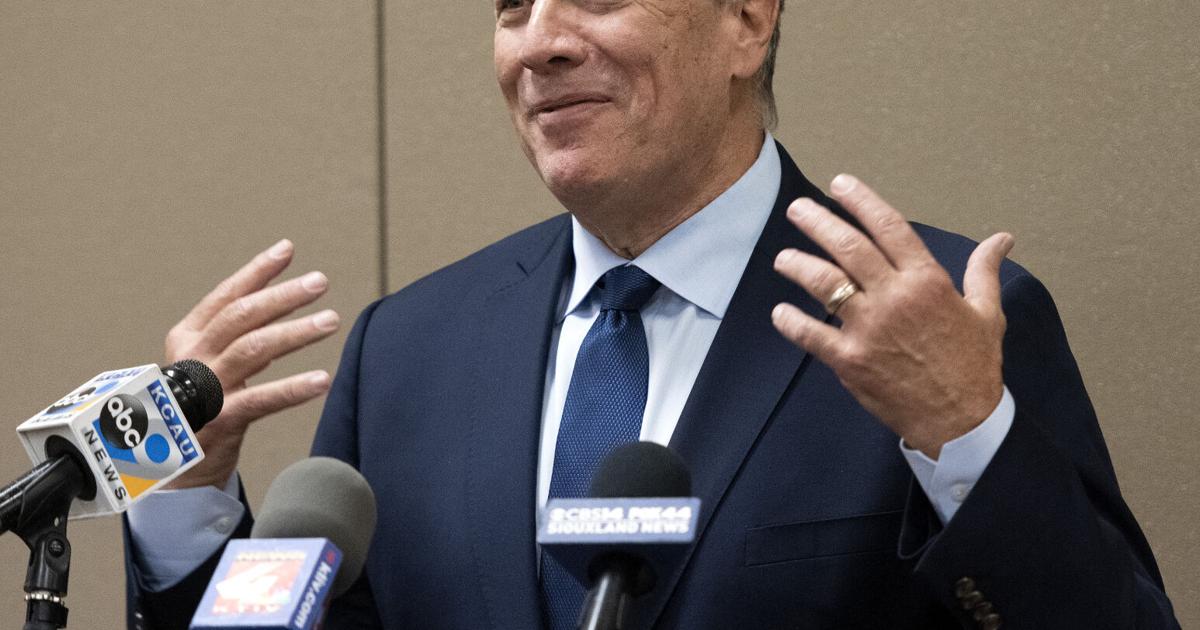
On this week’s edition of the On Iowa Politics podcast: allegations of unwanted advances by Mike Franken are unearthed, the White House gets a little passive-aggressive with Gov. Kim Reynolds over pandemic relief funding and Mike Pompeo’s latest Iowa trip.
On Iowa Politics is a weekly news and analysis podcast that aims to re-create the kinds of conversations that happen when you get political reporters from across Iowa together after the day's deadlines have been met.
This week’s show is hosted by The Gazette’s Des Moines Bureau Chief Erin Murphy and features Gazette deputy bureau chief Tom Barton, Lee Des Moines Bureau Chief Caleb McCullough, Sarah Watson of the Quad City Times, Jared McNett of the Sioux City Journal, and Gazette Opinion Editor Todd Dorman.
The show was produced by Stephen M. Colbert, and the music heard on the podcast is courtesy of Iowa bands Porch Builder and Copperhead.
I recently moved out of my flat of six years, and I’ve been housesitting until I find the perfect place. It’s been glorious to dote on my friends’ plants and test out new areas, but I’m never quite comfortable using another person’s kitchen as intensely as I would my own. So I’ve been living a low-cook lifestyle.
I can’t recommend it enough. Outside my borrowed kitchens, there’s been fabulous onigiri from a nearby deli, gorgeous pizza and the best pasta.
Still, a woman can’t live on takeaways alone (no matter how hard she tries). The recipes below are all perfect for the weather and my energy level.
Traybake feta with chickpeas and tomatoes
In a spread of Greek appetisers, or meze, there’s often a warm feta dish like bouyiourdi (baked feta with tomato and hot peppers) or a saganaki (fried cheese). This recipe combines elements of these two classic appetisers into a traybake meal. Softened feta provides a salty, creamy counterpoint to sweet, juicy tomatoes and chickpeas that are sticky from honey and spicy from dried chilli. Try this version, then riff wildly: switch out tomatoes for mini peppers, olives, dates or cauliflower. Swap the hot honey for anchovies, harissa, smoked paprika or turmeric. Eat with pita, grains, salad greens, hummus or yoghurt.
By: Ali Slagle
Serves: 4
Total time: 40 minutes
Ingredients:
500g cooked chickpeas (homemade or two 425g cans), drained, rinsed and shaken dry
450-560g cherry or Sungold tomatoes
1 shallot, thinly sliced
60ml extra-virgin olive oil
2 tbsp honey
1 tsp mild chilli flakes (like gochugaru) or ½ tsp red-pepper flakes
Salt
2 (170-225g) blocks of feta (see tip), sliced 2½cm-thick
Method:
1. Heat the oven to 200C. On a baking tray, stir together the chickpeas, tomatoes, shallot, olive oil, honey and chilli flakes. Season with salt, then spread in an even layer. Arrange the feta among the chickpeas. Roast until the feta and tomatoes are soft and the chickpeas are golden brown, 30 to 35 minutes (no need to stir). Eat right away (the feta will harden as it cools; reheat leftovers).
Tip: Avoid feta made with cow’s milk, which does not have enough fat to withstand roasting.
Cheesy kimchi noodles
Instant ramen ranks highly among comfort foods because it can be quickly prepared and those little seasoning packets provide lots of flavour with minimal effort. No packets are used in this recipe, but the addition of gooey, melted cheddar and funky fermented kimchi makes the dish even more satisfying. Sautéed spring onions and garlic balance out the spicy driracha, soy and sesame sauce, while the runny yolk from a crispy fried egg adds richness and mellows the spice. The cheese becomes sticky as it cools, so these noodles are best served immediately while still warm and glossy.
By: Lara Lee
Serves: 2
Total time: 20 minutes
Ingredients:
For the noodles:
170g dried instant noodles (see tip)
1½ tbsp canola oil, plus more for coating cooked noodles
2 eggs
5 spring onions, thinly sliced on the diagonal (reserve 1 tbsp for garnish)
½ (packed) cup kimchi, sliced
3 garlic cloves, peeled and finely chopped
1 tbsp black (or white) sesame seeds, plus more for garnish
½ cup grated cheddar
For the sauce:
2 tbsp sriracha
1 to 2 tbsp soy sauce
1 tbsp sesame oil
1 tbsp Shaoxing wine
Method:
1. Bring a medium saucepan of water to a boil over high. Add the noodles and cook according to the package instructions until tender but still springy, about 2 to 3 minutes. Transfer to a colander and rinse in cold water until cool, then toss with a splash of canola oil to prevent the noodles from sticking together. Set cooked noodles aside.
2. Meanwhile, prepare the sauce: in a small bowl, whisk the sriracha, soy sauce, sesame oil and Shaoxing wine; set aside.
3. Set a medium nonstick frying pan over high heat. Add ½ tbsp canola oil and, once shimmering, crack in the eggs. Reduce the heat to medium and cook until the whites are done and the edges are browned, 2 to 3 minutes. Transfer to a plate.
4. In the same pan, heat the remaining 1 tbsp canola oil over medium-high. Add the spring onions, kimchi, garlic and sesame seeds, and cook for 1 minute until just softened, stirring frequently. Add the noodles and sauce, and toss to combine for 1 minute. Stir in the grated cheese until it melts. Turn off the heat.
5. Transfer the noodles to serving plates, top with the fried eggs and garnish with extra sesame seeds and spring onions. Serve immediately.
Tip: If you can’t find plain instant ramen noodles, you can also use two individual 85g ramen packages, discarding the flavour sachets or saving them for another use.
Grilled salmon salad with lime, chillies and herbs
(Getty/iStock)
Made of soft, supple salmon; crisp lettuces and vegetables; and a very savoury dressing run through with chillies and lime, this light salad is tangy and full of flavour. The dressing, based on nuoc cham, a traditional Vietnamese dipping sauce, has just enough fish sauce to give it depth and pungency without overpowering the brightness of the lime. You can substitute other fish, or even chicken, for the salmon. Just adjust the grilling time as needed, and toss with the dressing while still warm. Note that if you don’t have a grill, you can roast the fish in the oven.
By: Melissa Clark
Serves: 4
Total time: 30 minutes
Ingredients:
2 limes
2 small fresh red or green chillies or 1 large one, thinly sliced, seeds removed if you like
1 shallot (or 2 spring onions, or 2 tbsp red onion), thinly sliced
2 tbsp fish sauce
Salt
Pinch of sugar
60ml extra-virgin olive oil or grapeseed oil, plus more for brushing
560g salmon fillet, preferably 1 large centre-cut piece
100-120g salad greens, such as little gem, iceburg or butterhead lettuce
50g mixed soft herbs (such as coriander, mint and basil), leaves and tender stems
115g thinly sliced radishes, cucumbers or both (optional)
Method:
1. Light the grill for indirect heat, or heat the oven to 230C.
2. As the grill or oven heat up, make the dressing: halve 1 lime, and squeeze its juice into a small bowl. Add the chilli slices, half of the sliced shallot (save the rest for serving), the fish sauce and a pinch each salt and sugar. Let sit for 1 minute to dissolve the salt, then whisk in the olive oil. It won’t emulsify, so mix again before using.
3. Brush the salmon with oil, and place it in a grilling basket if you have one. Cook over the indirect (unlit) side of the grill, for 2 to 5 minutes per side, depending on how hot the grill is and how thick the salmon is. Note that individual fillets will cook faster than a single large piece. Check the salmon often (alternatively, roast the salmon on a baking tray in the oven, until just cooked to taste, 7 to 12 minutes; you don’t have to flip it).
4. As the salmon cooks, halve the other lime. Brush the cut sides with olive oil and grill, cut-side down, over direct heat until charred, about 1 minute. If using the oven, throw the halves, cut-side up, on the roasting pan with the salmon. They won’t char, but they will cook and mellow in flavour, which is the aim.
5. When the salmon is cooked, transfer it to a plate and spoon some dressing over it. Let it cool slightly, then break up the fish into large chunks.
6. Place greens, remaining shallots, herbs, and radishes or cucumber, if using, in a large shallow bowl or on a platter, and add a little more of the dressing. Squeeze some of the juice from a charred lime half over it and drizzle with a little olive oil. Toss and taste, adding lime juice, olive oil or salt as needed.
7. Top with the salmon chunks and drizzle with more (or all) of the dressing. Serve with the remaining charred lime half on the side for squeezing.
Five-minute hummus
(Getty)
Michael Solomonov and Steven Cook of the Philadelphia restaurant Zahav found success with their hummus recipe, but in their second book, Israeli Soul, the two came up with this smart version, done in a fraction of the time of the original. It’s just as satisfying, and packed with tahini flavour, a given since it calls for a whole 450g jar. The end result is nutty and smooth, and topped with roasted vegetables, a worthy weeknight meal.
Recipe from: Michael Solomonov and Steven Cook
Adapted by:Krysten Chambrot
Makes: 4 generous cups
Total time: 5 minutes
Ingredients:
¼ garlic clove
Juice of 1 lemon, about 60ml
1 (450g) jar tahini
1 tbsp salt
1 tsp ground cumin
230-350ml ice water
2 (425g) tins chickpeas, drained and rinsed
Method:
1. Drop the ¼ garlic clove into a food processor and add the lemon juice. Pour the tahini on top, making sure to scrape it all out of the container, and add the salt and cumin. Process until the mixture looks peanut-buttery, about 1 minute. Stream in the ice water, a little at a time, with the motor running. Process just until the mixture is smooth and creamy and lightens to the colour of dry sand.
2. Add the chickpeas and process for about 3 minutes, scraping the sides of the bowl as you go, until the chickpeas are completely blended and the hummus is smooth and uniform in colour.
A 12-year-old girl from Texas shot her father as part of a plot with her friend to murder their families and run away from home, according to authorities.
The girl and her friend had planned the murder plot for weeks, the Parker County Sheriff’s Office said. They had allegedly plotted to kill their families and their pets before fleeing together to Georgia.
But the girl's friend never went through with the plan, according to the sheriff's office.
A 12-year-old girl from Texas shot her father as part of a plot with her friend to murder their families and run away from home, according to authorities. (Parker County Sheriff's Office)
Deputies responded to a shooting at a home in Weatherford, Texas, on Tuesday at about 11:30 p.m.
The girl was found lying in the street with an apparent self-inflicted gunshot wound to the head and a handgun lying beneath her. Her father was found inside the home with a gunshot wound to the abdomen.
Both the girl and her father were flown to the hospital. Their current conditions are unknown.
The girl appeared to have shot her father and fled the scene before shooting herself, investigators said.
She was planning to drive to Lufkin, Texas, to pick up her friend and then drive to Georgia.
The Parker County Sheriff’s Office has charged the friend with criminal conspiracy in the planning of the murder plot, according to the sheriff's office.
The Parker County Sheriff’s Office has charged the friend with criminal conspiracy in the planning of the murder plot, according to the sheriff's office. (Parker County Sheriff's Office)
The girls' motives remain unclear. Lufkin Police are also investigating the incident.
"Due to the injuries, the age of the juveniles and the sensitive case matter, information released regarding this case will be limited," Parker County Sheriff Russ Authier said in a statement.
The sheriff’s office said it does not identify juvenile suspects and will not be releasing the identity of the adult victim in order to protect the children.
Rep. Liz Cheney (R-Wyo.) vowed this weekend to do "whatever it takes" to prevent former President Trump from securing the GOP nomination in 2024.
Why it matters: Cheney, whose outward criticism of the former president has made her a pariah in the Republican Party, said during the Texas Tribune Festival that she will leave the GOP if Trump wins the nomination.
Driving the news: "I certainly will do whatever it takes to make sure Donald Trump isn't anywhere close to the Oval Office," Cheney told Texas Tribune CEO Evan Smith.
“I'm going to make sure Donald Trump, make sure he's not the nominee,” Cheney said. “And if he is the nominee, I won't be a Republican."
"One of the things that has surprised me the most about my work on this committee is how sophisticated the plan was that Donald Trump was involved in and oversaw every step of the way," Cheney said during the festival.
"It was a multipart plan that he oversaw, he was involved in personally and directly."
"While leaders in Congress were begging him, ‘Please, tell the mob to go home,’ Donald Trump wouldn't,” she said.
“And just set the politics aside for a minute and think to yourself, ‘What kind of human being does that?’”
The big picture: Cheney, who reiterated her commitment to conservative policies, said that people should "not doubt" her ability to fight Trump even after leaving office.
She did not answer whether she will run for president in 2024.
“It's really important not to just immediately jump to the horse race and to think about what we need as a country,” Cheney said.
The Central Intelligence Agency and the National Security Agency both recently overhauled their showcases of espionage.
WASHINGTON — Two of the United States’ intelligence agencies have completely renovated their museums of spycraft, displaying dramatic stories of notable U.S. spies and informants, as well as paraphernalia from intelligence work. But one of the museums will remain off limits to the public.
In time for its 75th anniversary this year, the Central Intelligence Agency has overhauled and refurbished its museum of secrets. It features spy gadgets both successful (a Tabasco sauce-covered dead rat in which to hide messages) and not (a pigeon-mounted camera and a mini spy drone designed to look like a dragonfly). It has fascinating, beautifully arranged artifacts from significant espionage operations.
Doug Mills/The New York Times
However, the C.I.A. Museum is on the agency’s heavily protected campus in Langley, Va., a location that is not open to members of the public — unless they find themselves summoned to its headquarters. The C.I.A. opened the renovated museum to family of personnel one weekend and to members of the news media Saturday.
Many of the artifacts are celebrations of the agency’s triumphs. The museum has a model of Osama bin Laden’s compound and a brick taken from the site. There is art made by the great comic book artist Jack Kirby, used by the C.I.A. as props for a fake movie production company in an operation to rescue diplomats in Iran (depicted in the 2012 movie “Argo”). And there are disguises worn by people while working to salvage the wreck of a Soviet submarine carrying nuclear missiles from the ocean’s floor.
There is a reconstruction of the tunnel under East Berlin that allowed the United States to tap into Soviet communications for roughly 18 months.
One of the newest additions to the collection of artifacts is a model of the building in Kabul where Ayman al-Zawahri, the Qaeda leader, was hiding when he was killed by a U.S. drone strike in July. The C.I.A. placed the model in a wooden box when it was brought to President Biden to discuss the operation, and the bottom of the box can be seen in the C.I.A. display case.
Doug Mills/The New York Times
Doug Mills/The New York Times
Perhaps in part because it is restricted from the general public, the C.I.A. Museum does not shy from the agency’s failures: operatives caught by governments, moles who give away informants, the groupthink of the Iraq war, the Bay of Pigs.
“A big part of this museum is for our officers, and for them to know the lessons of the past,” said Robert Byer, the director of the C.I.A. Museum. “For that reason, we cannot just be sugarcoating our history or touting our successes. We really have to make sure this is a full history of the C.I.A. so they can understand their history and do a better job because of it.”
Among the museum’s carefully crafted exhibits is the story of Martha Peterson, the first female case officer sent to work in Moscow. Her assignment was to collect and pass information to an operative who was a Soviet diplomat, to whom she would also provide a suicide pill to use if he was captured. The diplomat ultimately was seized and died by suicide, leading to Ms. Peterson’s arrest while she was placing a message in a dead drop.
While the C.I.A. gathers intelligence, conducts analysis and executes covert operations, the National Security Agency focuses on collecting electronic communications and making and breaking codes. That is the focus of its reimagined showcase at the National Cryptologic Museum in Annapolis Junction, Md.
The museum of the N.S.A., sometimes called “No Such Agency” in a nod to its secretive practices, was designed to be accessible to the public, a contrast with the C.I.A. Museum.
“It’s a wonderful paradox that ‘No Such Agency’ has the only museum in the U.S. intelligence community that’s completely open to the public,” said Vince Houghton, the museum director.
The cryptological museum closed in 2020 amid the Covid pandemic and Dr. Houghton, a former historian and curator at Washington’s popular International Spy Museum, used the time to renovate the building and meticulously search the National Security Agency’s archives of equipment.
“There are things that people didn’t know existed, and there are things that people had thought had been lost for decades,” Dr. Houghton said.
Doug Mills/The New York Times
In the museum, which reopens Oct. 8, Dr. Houghton emphasizes unique artifacts amid exhibits filled with strangely fascinating code-making and code-breaking machines. Its collection extends from the United States’ earliest days to the present. From World War II, there is the machine that broke Japan’s diplomatic encryption, and another that broke the German naval codes. There is also an Enigma machine used by Adolf Hitler, displayed behind glass; there are other ones that visitors can touch and use.
Dr. Houghton said almost all the artifacts he displays meet one of three criteria: They are the only remaining object of their kind; they are the first of something; or they were used by a specific person.
“I call it the holy trinity of artifacts,” he said.
Doug Mills/The New York Times
Doug Mills/The New York Times
The museum sticks to its mission of explaining cryptology to a broad section of the public. It acknowledges some losses: There is a memorial wall and displays that tell the stories of cryptologists killed in combat. But for the most part, the focus is on the machines and the code breakers who ran them.
There’s not much on the turncoats, however. One exhibit shows the tools that John Walker, a Navy warrant officer and Soviet spy, used to try and steal American codes for the Russians. But there is no mention of Edward Snowden, the N.S.A. contractor who revealed many of the agency’s secrets and then fled to Russia. (Because the Snowden case is an ongoing Justice Department investigation, the museum is limited in what it can say.)
The C.I.A. Museum, on the other hand, has multiple examples of spy games ending in failure or tragedy. It highlights the stories of C.I.A. officers wrongly accused of being spies and lays out the damage done by Soviet moles.
Doug Mills/The New York Times
Among the collaborators whose work is celebrated is Adolf Tolkachev, an aviation electronics engineer. He reached out multiple times to the C.I.A. to offer his help, angered at the persecution of his wife’s parents under Joseph Stalin. In 1978, he got though to the Americans and used miniature cameras to pass on images of Russian secrets.
The value of Mr. Tolkachev’s intelligence, which vastly expanded American knowledge of Soviet missiles and fighter planes, earned him the moniker “the billion dollar spy.” While he was good at getting documents, he was not good at taking pictures. The museum includes a camera the C.I.A. built for Mr. Tolkachev, with a fixed focal length to ensure his pictures would be less blurry.
But his story also ends badly. Aldrich Ames and Edward Lee Howard, C.I.A. officers working for the Russians, gave up Mr. Tolkachev’s identity. He was arrested in June 1985 and executed in 1986.
“I feel I have a responsibility: It cannot be a rah-rah version of history,” Mr. Byer said. “Museums need to tell the truth.”
The Fort Lupton Police Department released body camera and dashcam video on Friday showing Yareni Rios-Gonzalez inside the patrol car that was hit by a train. Rios-Gonzalez is hospitalized with multiple injuries but is expected to survive, the Colorado Bureau of Investigations said.
The newly released video of the September 16 incident shows Rios-Gonzalez -- a suspect in a road rage case -- asking why she was pulled over as she is handcuffed and put into a cruiser that was parked on railroad tracks, yards behind her truck.
Rios-Gonzalez is left in the vehicle alone as officers search her truck. Minutes later, a train horn is heard and officers express alarm as the train barrels into the cruiser, crumpling the side and pushing it dozens of feet into a field. Officers can be heard on the video calling for medical assistance.
Paul Wilkinson, an attorney for Rios-Gonzalez, told CNN Saturday that she was desperate to get out of the vehicle as the train approached.
"When she was in the back of the car, she was able to see the train coming," Wilkinson said. "She was frantically trying to escape, trying to open the doors, but she was handcuffed."
Rios-Gonzalez tried to get out of the cruiser on her own and attempted to get the attention of officers by screaming, Wilkinson said.
"I don't know if they just couldn't hear her or if they were too busy searching her car, but she saw it coming and prepared for the worst," he said. "And as you can imagine, lost consciousness and woke up at the hospital. She's obviously very upset."
Rios-Gonzalez sustained multiple injuries, including nine broken ribs, a broken arm, broken teeth and injuries to her head, according to Wilkinson. As of Saturday, she remained in the hospital.
The vehicle that was hit was a cruiser from the Platteville Police Department, which was assisting with the traffic stop. Platteville Police Chief Carl Dwyer said the officer who parked on the railroad tracks has been placed on paid administrative leave pending an investigation by the CBI. Neither police department has identified any of the officers involved in the incident.
Fort Lupton police say the case they were pursuing against Rios-Gonzalez has been referred to the Weld County District Attorney.
Krista Henery with the Weld County District Attorney's Office told CNN on Saturday that "everything is still being investigated and no charges have been filed for the suspect/victim or any officers."