Minggu, 09 Juli 2023

Former Democratic Tennessee lawmaker Roy Herron dies after jetski accident Tennessee Lookout - Tennessee Lookout

Roy Brasfield Herron, former state lawmaker and former chair of the Tennessee Democratic Party, died in Nashville’s Vanderbilt University Medical Center on Sunday, one week after sustaining injuries in a jetski accident on Kentucky Lake. He was 69. 

“Roy loved his family with all his might,” said the Rev. Nancy Carol Miller-Herron, Roy’s spouse of 36 years, in a statement. “He passed doing what he loved most—spending time with our sons and their friends in the Tennessee outdoors where his spirit was always most free.”

A native of Dresden, Tenn., Herron graduated from the University of Tennessee at Martin before getting a joint Master’s of Divinity and law degree from Vanderbilt University. 

Roy Herron. (Photo: Herron Law)

He was first elected to the Tennessee General Assembly in 1986 as a state representative, taking the seat held by Ned Ray McWherter, who was elected governor the same year. In 1996, he was elected to the Senate, where he rose to become chair of the Senate Democratic Caucus — at a time Democrats held solid majorities in both the House and the Senate.  

In 2010, he was the Democratic nominee for Congress in the 8th Congressional District, losing to Crockett County farmer Stephen Fincher. The Tennessee Democratic Party executive committee elected Herron chairman in 2013, where he served one two-year term. He authored four books and numerous articles. 

Herron was known by friends and colleagues to have a strong moral compass, a fierce work ethic,  unparalleled debating skills and devotion to his Methodist faith and to his family. His brand of Democratic politics was centered around improving life for Tennesseans and particularly through shoe leather work in his district for working men and women. 

His interest in politics came early and even before he held electoral office, he worked tirelessly to assure Democrats were elected — including, in his successful 1984 U.S. Senate run, former Vice-President Al Gore. 

Many of those who knew Herron thought him invincible. A marathon runner, he also finished numerous Ironman Triathlons, legendarily grueling races consisting of a 2.4 mile swim, 112 mile bike ride and a 26.2 mile full marathon.

In 2011, Herron landed in Vanderbilt Medical after a bike accident while training for an Ironman cost him nine broken ribs, a broken collarbone and a bruised lung. He missed no portion of the legislative session while recovering, telling a West Tennessee news outlet he had missed once for the birth of his son. 

“No one of our generation got up earlier, ran more miles, put in longer hours, covered more ground, listened to more people, took more notes and wrote and spoke more eloquently,”  said Nashville lawyer Tom Lee, a longtime friend of Herron’s.  “You might beat him, but you weren’t going to outwork him. And you weren’t going to worry about whether you still had a friend in him when it was all over.” 

In recent years Herron, along with McWherter and former Democratic lawmakers Craig Fitzhugh and Mark Maddox,  formed the Volunteer Center for Rural Development, an organization that developed educational programs with an emphasis on Tennessee issues, and he lobbied the legislature on behalf of public education issues.

“I will miss my dear friend. My seat mate in the House, he was a remarkable human, passing strong and reforming legislation in so man areas: crime victims, education, school religious liberty, ethics, healthcare, predatory lending,” said Fitzhugh, now mayor of Ripley, Tenn.

“His accomplishments are legion, top among them his love and concern for family and others. His counsel, his strong faith, his tireless efforts will be missed. And yes, even his early, early morning phone calls.” Fitzhugh said. “His family is on my heart.”

Randy Ford, who helped Herron start his 1996 state senate campaign, said Herron was reluctant to mix politics and religion but had agreed to preach one last sermon at a Methodist church before launching his campaign.

“He felt like he needed to honor the commitment he had made,” said Ford. “I remember listening to him that day, thinking that I would not want to run against him. It’s ironic that when he ran for the U.S. House, his opponent refused to debate him.”

In addition to Nancy Carol, Roy is survived by his three sons, John, Rick, and Benjamin; his brother, Ben; and many beloved cousins, nephews, and nieces. Funeral arrangements are pending, but services are expected to be held on Saturday at First United Methodist Church in Martin, Tennessee.

Adblock test (Why?)


from U.S. - Latest - Google News https://ift.tt/YU02FVd
via IFTTT

GOP states quit the program that fights voter fraud. Now theyre scrambling. - Yahoo News

Over the past year and a half, eight Republican-led states quit a nonpartisan program designed to keep voter rolls accurate and up to date.

Top Republican election officials in those states publicly argued the program was mismanaged. The conspiracy theorists who cheered them on falsely insisted it was a front for liberals to take control of elections.

But experts say the program, known as the Electronic Registration Information Center, was among the best nationwide tool states had to catch people trying to vote twice in the same election. Now, those Republican-led states who left — and other states who lost access to their data — are scrambling to police so-called “double voters” ahead of the presidential election in 2024.

In recent months, elections officials in Ohio — one of the states that led the flight from ERIC — and elsewhere have been quietly convening leaders from dozens of states to talk about ways they can still work together to try to catch double-voters.

“The whole goal is to have something in place, state-to-state, prior to the 2024 election,” Amanda Grandjean, Ohio's assistant secretary of state and senior adviser, told POLITICO, the first time she has spoken publicly about the efforts.

The scramble by states to fill a security gap left open by exiting ERIC comes at a critical time. Elections officials face ongoing scrutiny about the accuracy of voter rolls after extensive — and untrue — accusations of widespread fraud in the past two election cycles. The 2024 elections are getting closer.

Grandjean said 27 states have expressed interest in the effort, with varying degrees of commitment.

But actually getting it off the ground is a different matter.

Grandjean declined to share a complete list of participants, but said there has been a “bipartisan” working group which also includes states that remain active members of ERIC. She said states have been meeting weekly to discuss the structure of the program. States she mentioned that have been actively involved in conversations include West Virginia, Florida and Virginia — three states that left ERIC — as well as Georgia, which remains in ERIC and whose Republican secretary of state, Brad Raffensperger, has been one of the organization’s chief public defenders.

In a text message, a spokesperson for Raffensperger confirmed that his office is “trying to work out agreements with several non-ERIC states,” but said they had no further details to share. A spokesperson for the Virginia elections department told Virginia Public Media in May — shortly after the state announced its intention to pull out of ERIC — that it had “been participating in talks with other states for several months” on a potential double-voter program, but declined to answer further questions about the effort.

Interstate double voting — someone successfully or trying to cast a ballot in the same election in two different states — is widely believed by election officials to be rare. But it does happen. Election officials, and Republican politicians, have praised ERIC in the past as a key tool that has helped them catch cases.

In the interview, Grandjean stressed that the new effort she is trying to rally support for is “not meant to be something that’s comparative” to ERIC. It would be structured entirely differently, based on individual states signing data sharing agreements with one another, and not a more centralized database structure.

“There's no bylaws, there's no membership agreement,” she said. “It's just sharing information with each other.”

But that also means that any arrangement will be much more limited in practice than ERIC. One of ERIC’s biggest values was serving as a central clearinghouse for states’ data that they used to update voter rolls, either by scrubbing out-of-date registrations or finding potentially eligible but unregistered voters. Those two things are much harder, if not impossible, to replicate with one-on-one agreements between states.

The future of ERIC also remains uncertain.

The states that left have denied that the attacks from conspiracy theorists had anything to do with the rush for the exits. Grandjean, who at one point chaired ERIC’s board, said she did not want to “relitigate” the fight but that it was “unfairly” portrayed in the media. Instead, most of the states that left said it was due to a fight over efforts to change the composition of ERIC’s board to remove a non-voting member and disagreements over what member states had to do with the data collected and distributed by the organization — something that many of the remaining states dismissed as a false pretense put forward to justify an exodus and score political points.

Twenty-six states and the District of Columbia are currently members of the organization — a number that includes Virginia, whose resignation is set to take effect next month. Efforts are underway in New York and California to potentially join the organization, but that number could further dwindle in the future as well.

Texas Gov. Greg Abbott, a Republican, signed a law late last month that would allow the state to leave the program.

And Kentucky Secretary of State Michael Adams — a Republican who has also vocally defended ERIC — recently acknowledged his state is also looking at alternatives.

In a statement late last month, Adams said ERIC has been weakened because there are less participating states contributing data, increasing costs and decreasing utility to remaining states.

“While my administration will never cave to conspiracy theorists, it nevertheless is true that the value of ERIC to us going forward is a debatable question,” he said. “Kentucky is about to pay a lot more money to get a lot less information.”

Adblock test (Why?)


from U.S. - Latest - Google News https://ift.tt/8CG5UMc
via IFTTT

Sabtu, 08 Juli 2023

"It's really dangerous": Surfers face "chaotic" waves and storm surge in hurricane season - CBS News

As Hurricane Irma raged in the Caribbean at the peak of the 2017 Atlantic hurricane season, rising professional surfer Zander Venezia, a teenager, died in a sudden drowning while trying to ride mega-swell waves in Barbados. It was neither the first nor the last time a surfer's attempt to venture out during a storm surge ended in tragedy.

"It's really common when we're in September and having those hurricane conditions to have a very unexpected storm surge," said Corey Senese, a lifelong surfer who founded and gives lessons at CoreysWave, a surfing school in Montauk, New York. 

"We do have a few terrible, tragic stories involving storm surges," Senese told CBS News. "It's really dangerous because you're not expecting it."

Senese noted that surfers, swimmers and beachgoers alike contend with potentially perilous circumstances year-round, like sneaker waves, rogue waves, undertow and rip currents, which can be deadly. 

Storm Kicks Up Surf In Log Island
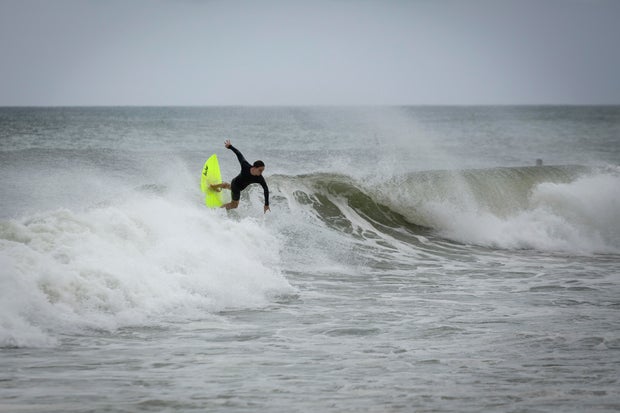
A surfer takes on 5- to 7-foot swells coming off the Atlantic Ocean on Oct. 5, 2015 in Lido Beach, New York, as Hurricane Joaquin passes by the northeastern coast of the United States. Bruce Bennett / Getty Images

Storm surges — abnormal rises in water levels generated by storms — can be seen any time of year but are mainly linked to hurricanes and other strong tropical storm systems. They can pose serious threats during hurricane season, which began on June 1 and lasts until Nov. 30. 

What is a storm surge? What causes it?

The National Oceanic and Atmospheric Administration predicted in May that the 2023 hurricane season would be "near normal," but in early July, scientists from Colorado State University said their forecast now calls for "an above-average" season. They said the outlook is more uncertain than normal because of unusually warm sea surface temperatures in portions of the Atlantic Ocean and the arrival of an El Niño.

Hurricanes produce powerful winds — in a Category 5, reaching 157 miles per hour or more. And while those winds can be devastating, scientists say the greatest threat to life in a hurricane is posed by storm surge, which is an abnormal rise in water levels caused by hurricane-force winds pushing that water toward shore and over areas of land that are normally dry.

TOPSHOT-CUBA-WEATHER-HURRICANE-IAN
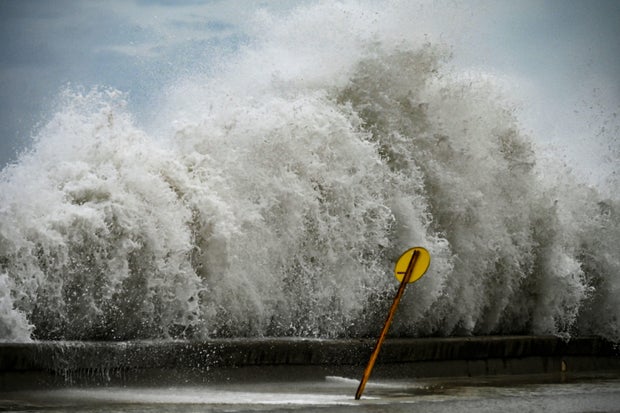
Waves hit the Malecon in Havana, Cuba, on Sept. 28, 2022, after the passage of Hurricane Ian.  YAMIL LAGE/AFP via Getty Images

As a surge advances and combines with normal, astronomical tides, a 15-foot surge occurring on top of a high tide that is already 2 feet above average sea level would produce a 17-foot storm tide. In the worst instances, water levels can rise 30 feet or more, according to NOAA, as it did with Hurricane Katrina, a Category 3 storm that caused catastrophic damage when it made landfall in New Orleans in 2005.

More intense hurricanes produce higher storm surges, according to the National Hurricane Center, which cites a storm's maximum wind speeds and the size of the storm as two important factors in determining the extent of a surge. Larger hurricanes and stronger winds correlate with greater storm surges, although surges can also be influenced by other factors like atmospheric pressure, the shape of the coastline as well as the ocean floor, and the angle at which a hurricane approaches coastal land.

The geography in certain places — along the Gulf Coast in the United States, for example — lends itself to particularly severe storm surges, and that sensitivity means less force is required on the part of the hurricane to trigger a higher surge.

"You can take the same hurricane, with respect to how big it is and how strong it is, and if you allow it to make landfall on different parts of the coastline within the United States, you might get a different result with respect to how high the water is in any given area," Cody Fritz, a storm surge specialist and team lead of the Storm Surge Unit at the National Hurricane Center, told CBS News. 

Why are storm surges so dangerous?

A storm surge can inundate surrounding regions with water, threatening beaches, coastal highways, boats and buildings. If there are smaller bodies of water nearby, like lakes or rivers, storm surge can exacerbate flood risks in those areas, too, as it moves inland.

"Storm surges are brutal and can bring down a town or fishing village in less than a minute," said Luís Madureira Pinto, founder and manager of the website SurferToday.com, who has been surfing for roughly three decades. 

Pinto is based in Porto, a coastal city in northwest Portugal where surfing is popular, and which has in recent years weathered several destructive storm surges that brought excessive flooding.

"The problem with storm surges is that these waves tend to be chaotic and do not have a regular breaking pattern. They break here and there, they're bigger and smaller," he said, adding that a storm surge "can change the quality of the wave dramatically."

"When it comes to surfing, there is only one wise option — do not paddle out," Pinto told CBS News in an email. "It's dangerous and totally useless." 

A surfer rides a wave in Deerfield Beach, Florida
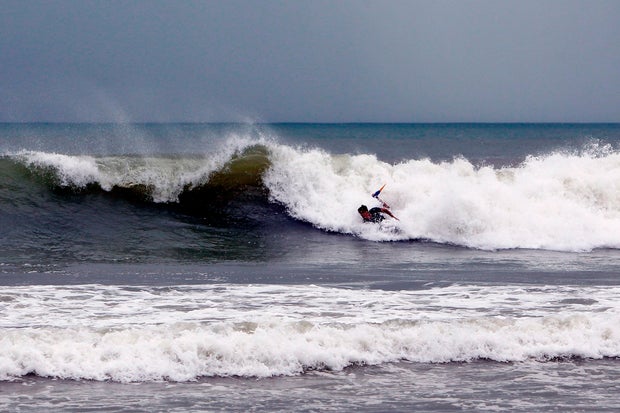
A surfer rides a wave in Deerfield Beach, Florida, on Sept. 3, 2019, as Hurricane Dorian moves closer to Florida.  EVA MARIE UZCATEGUI/AFP via Getty Images

Storm surges are dangerous for a number of reasons. Just six inches of fast-moving flood water can knock over an adult during a surge, creating a serious threat of drowning, according to the National Hurricane Center. Two feet of rushing water is enough to sweep away vehicles of almost any size. 

Surges can also happen at seemingly random intervals before, during or after a storm, and can cause water levels to rise substantially in minutes, so heeding evacuation notices and other safety protocols ahead of time is important and could be life-saving.

Be aware of warnings and risks

While storm surges cannot be prevented, weather experts have systems in place to track them, allowing communities in the expected path of a hurricane to prepare. 

To evaluate the risk of a storm surge, forecasters use a computer modeling system called Sea, Lake and Overland Surges from Hurricanes, or SLOSH, which was developed by the National Weather Service. It can estimate surge heights based on water depths, land elevation and barriers to the flow of water in an area where a storm is headed. Accuracy depends on how closely forecasters can approximate key properties of the hurricane itself, including its trajectory, intensity and size. 

Predictions that emerge from the modeling system help inform the alerts, recommendations and public safety protocols during weather emergencies, like evacuations. Fritz, with the National Hurricane Center, underscored the value of those warnings.

"I wouldn't advise being out in the areas where a storm is approaching," he said. "When a storm surge comes in it can be very fast and destructive. It's not something that any one person should kind of mess with. I mean, there's a reason why we put out warnings to alert the public about the dangers of storm surge, because it is life threatening, ultimately."

PUERTORICO-WEATHER-HURRICANE-STORM
A surfer rides a wave in the waters at La Pared Beach in the aftermath of Hurricane Irma in Luquillo, Puerto Rico, on Sept. 7, 2017.  RICARDO ARDUENGO/AFP via Getty Images

For athletes like Senese, who, at 41, has now been surfing at beaches across the country for about 35 years, staying safe in the water, particularly during hurricane season, means monitoring daily weather forecasts and observing wave patterns in real time.

"Any surfer on the beach is always going to have just slightly more awareness of the waves just because of the problem that surfers have where they never stop thinking about waves. So usually you end up seeing it," Senese said. 

"Surfers have a bunch of different resources we use to check the surf, but you can always look at the wave size and have a good idea whether it's safe," he said.

Reconciling safety with the thrill of riding more dramatic waves can boil down to a surfer's experience and comfort levels, said Senese, who emphasized the importance of finding a personal "threshold" and — his principal piece of advice — resisting the impulse to panic no matter the conditions.

"When a hurricane slams our coast, it's important to be aware of all the dangers," says the narrator in "Making Waves," an audio and visual podcast from NOAA's National Ocean Service, during an episode focused on storm surge. "Don't take unnecessary risks during a storm. Conditions can change in the blink of an eye."

Adblock test (Why?)


from U.S. - Latest - Google News https://ift.tt/v8tgDow
via IFTTT

Jumat, 07 Juli 2023

Iowa teen jailed for killing Spanish teacher over bad grade - bbc.com

Police handout

A teenager in the US state of Iowa who beat his teacher to death with a baseball bat over a bad grade has been sentenced to life in prison.

Willard Miller, 17, pleaded guilty to first-degree murder in April for his role in the 2 November 2021 killing of Nohema Graber, a Spanish teacher.

Miller and co-defendant Jeremy Goodale, now 18, attacked Ms Graber, 66, after she marked down Miller's work.

Aged 16 at the time of the murder, both were charged as adults.

Goodale's sentencing is scheduled for August.

On Thursday, Miller was sentenced to life in prison with the possibility of parole only after at least 35 years.

Police handout

He was also ordered to pay at least $150,000 (£117,000) in restitution to the victim's family.

Before delivering his sentence, Judge Shawn Showers rejected defence arguments that Miller was too young at the time to understand the gravity of his actions.

"Evil does not have a birthday," he said.

Family members of Ms Graber told the court they did not believe Miller was remorseful.

Several relatives mentioned that the murder led to the early death last month of Ms Graber's husband, Paul. He was buried a day before Thursday's sentencing.

Miller apologised to the community and turned to address Ms Graber's relatives seated behind him.

"I am sincerely sorry for the distress I have caused you and the devastation I have caused your family," he said.

Pleading with the judge to forego the maximum sentence, Miller said: "I don't want to be institutionalised so long that I forget who I am and where I come from."

Prosecutors said the evidence showed both Miller and Goodale had bludgeoned Ms Graber with a bat during the attack in Fairfield, a town of fewer than 10,000 people that lies 100 miles (160km) south-east of the state capitol, Des Moines.

The day after the attack, police found the mother-of-three's body hidden under a tarpaulin, wheelbarrow and railway sleepers in a local park where she used to walk after school.

In a police interview, Miller described frustrations with the way Ms Graber taught Spanish.

He said his marks in her class were lowering his Grade Point Average, an important score during applications for US colleges and scholarships.

Miller met Ms Graber at Fairfield High School on the day of the murder to discuss his poor grade in her class. Goodale was also a student there.

Mexican-born Ms Graber had been employed at the school since 2012. She was part of the town's small but growing Latino community.

Related Topics

Adblock test (Why?)


from U.S. - Latest - Google News https://ift.tt/kyB3svp
via IFTTT

Kamis, 06 Juli 2023

Wisconsins Governor Raises School Funding for the Next 400 Years - The New York Times

Gov. Tony Evers used a quirky rule to edit the state budget and raise the cap on public school funding — until the year 2425.

It took only a few snips of creative editing for Gov. Tony Evers of Wisconsin to push through a long-term boost to public education funding.

And by long term, we mean long term.

As in, for the next 400 years.

On Wednesday, Mr. Evers, a Democratic former teacher and state superintendent, took advantage of a quirky, Wisconsin rule that has long given governors a partial veto, allowing them to amend laws with some editing trickery.

Governor Evers raised the amount that school districts could generate through property taxes by an additional $325 per student each year. In the original budget, the increase was allowed through the 2024-25 school year.

But with the slash of a hyphen and the snip of a “20,” Mr. Evers changed 2024-25 to the year 2425.

The proposed state budget had outlined two years of revenue limit increases, for the 2023-24 and 2024-25 school years. By editing out the text in red, Mr. Evers allowed increases until 2425.State of Wisconsin

State Republicans, who have made an art of blocking Governor Evers’s agenda, quickly condemned the veto, which also rejected a Republican tax cut plan that included relief for top-income brackets.

“Legislative Republicans worked tirelessly over the last few months to block Governor Evers’s liberal tax and spending agenda,” Robin Vos, the Republican speaker of the State Assembly, said in a statement. “Unfortunately, because of his powerful veto authority, he reinstated some of it today.”

Mr. Evers — who won his first term in 2018 in part by arguing that the incumbent, Gov. Scott Walker, a Republican, had not spent enough on schools — announced the changes without a hint of irony.

The new budget “ensures school districts have a level of budgeting certainty that they have not experienced” since cuts made after the Great Recession, his office said in a news release, adding that the revenue adjustments would continue “effectively in perpetuity.”

Over time, Wisconsin voters have whittled away at the state’s unusual veto authority. In 1990, voters took away the “Vanna White veto,” which had allowed governors to strike individual letters in words to create new words. In 2008, voters rejected the “Frankenstein veto,” which had involved combining parts of two or more sentences to create a new sentence.

Because Mr. Evers’s veto eliminated only entire words and digits, without combining two or more sentences to create a new sentence, it appeared to be legal, said Rick Champagne, director of the Wisconsin Legislative Reference Bureau, a nonpartisan agency that provides research and legal advice to state lawmakers.

“Governor Evers’s veto does adhere to the constitutional requirements for a partial veto,” he said in an email.

The law could be challenged or appealed.

In 2017, Mr. Walker, the former governor, executed what came to be known as the “thousand year veto” by striking the figures “1” and “2” from the date “Dec. 31, 2018,” — changing the date to “December 3018.” The edit, to a law involving school districts and energy efficiency projects, was challenged in court, but upheld by the Wisconsin Supreme Court on the grounds that the challenge was not brought in a timely manner.

“We have no case law on the legality of a partial veto that would affect law spanning centuries,” Mr. Champagne said.

Nationally, Wisconsin sits in the middle of the road when it comes to public-school funding. Adjusting for local costs, Wisconsin spent about $15,000 per student in the 2019-20 school year, in line with the national average, according to the Education Law Center.

The new budget does not automatically increase the state’s spending each year. Rather, it allows school districts to raise their total revenue amount — which comes from a combination of state aid and property taxes — by $325 per student every year, the largest increase to the revenue limit in Wisconsin in more than a decade. If the Legislature does not increase state aid in future years, school districts would have the authority to raise property taxes.

Predictably, there was little agreement about whether this was a good thing.

Tyler August, a Republican and majority leader of the State Assembly, called the governor’s move an “irresponsible veto that would blow the roof off of property taxes,” adding, “Taxpayers need to remember this when getting their tax bills this December.”

But Dan Rossmiller, the executive director of the Wisconsin Association of School Boards, told The Milwaukee Journal Sentinel that the change, while “certainly appreciated,” may not be enough to keep up with the rate of inflation for some districts.

“I wish the amount would have been higher,” he told the news outlet.

Adblock test (Why?)


from U.S. - Latest - Google News https://ift.tt/tWA1BRC
via IFTTT

Rabu, 05 Juli 2023

Philadelphia DA on what can be done to curb gun violence - PBS NewsHour

Larry Krasner:

You know, the problem with our Republican critics is, we actually tell the truth, and we have the information to back it up.

They have yet to come forward with anything that shows that our policies have endangered people in Philadelphia. The truth is, we're extremely good at the prosecution of violent crime committed with guns. We just know that it is more important to go after shooters than to act like anyone who possesses a gun, but failed to get a permit to carry it, is equally dangerous.

We did the numbers. The numbers look like this. One out of 100 people arrested for possession of a gun is going to turn up arrested as a shooter later, one out of 100. That's different than shooters; 100 out of 100 shooters are shooters.

So while it's very important to go after illegal gun possession, and we have a bunch of hurdles, including illegal police searches due to certain policing policies and certain changes in the law, while that's important, it is actually more important to go after people who are killing people with guns, shooting people with guns.

That is what we said from the beginning. The data shows we were right. The Philadelphia Police Department's behavior, in which they have come up with a new unit to investigate shootings, shows that, at some level, they agree that there is a difference between shooters and people who possess, some of whom might be shooters, but many of whom are not.

Adblock test (Why?)


from U.S. - Latest - Google News https://ift.tt/5Pa8hm7
via IFTTT

Selasa, 04 Juli 2023

Highland Park shooting victims remembered on Fourth of July - USA TODAY

HIGHLAND Park, Ill. – Thousands of people gathered Tuesday in downtown Highland Park for a remembrance ceremony and community walk one year after the mass shooting at a Fourth of July parade in this Chicago suburb.

Xochil Toledo, 24, and her family joined the crowd outside City Hall wearing t-shirts with an image of her grandfather, Nicolás Toledo, 78. The two were at the parade together last year when he was fatally shot.

"We're here today to honor him," she said. "It definitely is taking time to heal and process everything."

Last year, a 21-year-old gunman armed with an AR-15-style rifle opened fire from a rooftop over the town square, killing seven people and wounding 48 others. The victims included Toledo; Katie Goldstein, 64; Irina McCarthy, 35; Kevin Michael McCarthy, 37; Stephen Straus, 88; Jacki Lovi Sundheim, 63; and Eduardo Uvaldo, 69.

Year after shooting, Highland Park asks: What does freedom mean this Fourth of July?

The gunman, who traveled to Wisconsin and back before police apprehended him hours after the shooting, faces 21 first-degree murder counts, 48 counts of attempted murder and 48 counts of aggravated battery. His father also faces charges for helping the shooter obtain a gun license even though he had threatened violence.

In the wake of the shooting, Illinois passed a ban on dozens of high-powered semi-automatic weapons and high-capacity magazines. Survivors and victims' families also sued the gunman and his father, the gun manufacturer, the gun store where the gunman purchased the weapon and an online gun distributor.

Tuesday, people of all ages – many wearing blue "We are Highland Park" shirts and Fourth of July attire – attended the remembrance ceremony. Some cried quietly, couples leaned against one another and parents held tight to their children. Many became visibly emotional as the group sang the national anthem in unison.

"Even as the world moves on, the loss and the pain will never leave us," Mayor Nancy Rotering said. "To each of you, know this, we continue this journey together."

City officials read aloud the names of the victims and held one minute of silence. That's all the time it took that day for the shooter to fire 83 rounds into the crowd with a Smith & Wesson M&P 15 semi-automatic rifle, according to city officials.

Katherine McKeag, 18, attended the ceremony with her mother and other members of her synagogue, North Shore Congregation Israel, in honor of Sundheim. McKeag recalled Sundheim as a kind, driven member of the congregation who watched her grow up.

"She really valued her community and took care of all of us," McKeag said.

Linda Eisendrath attended in honor of Straus, a longtime friend whose children grew up with her own. Eisendrath's partner, Burt Skolnik, 86, reflected on fleeing from the parade that day. He was with his daughter and son-in-law in front of the Dairy Queen, near where the shooting happened.

"I'll never forget the sound of the rifle and seeing the people running. Utter shock," he said.

In his remarks, Rabbi Ike Serotta of Makom Solel Lakeside Reform Synagogue pointed to other incidents of gun violence in recent weeks and thanked community leaders from Chicago and across the country for supporting Highland Park in the aftermath. He said he still finds himself sometimes scanning rooftops and planning emergency exits.

"Resilience is a much better word than healing," he said, adding, "We can choose, as we are able, to live and love and play and move forward for good."

A slew of elected officials, including Illinois Gov. J.B. Pritzker and U.S. Sens. Dick Durbin and Tammy Duckworth, joined the group for the walk to reclaim the parade route. People pushed strollers and wheelchairs and spoke among themselves along the fenced path through downtown.

Toledo said her family was silent during the walk. It was a healing process, she said.

Holly Israel, 57, who sheltered-in-place for hours last year as law enforcement searched for the gunman, joined the walk with her family and dog. She said the event brought a sense of peace – maybe even closure.

"It was definitely spiritual," said Shawn Mathew, 24, an employee of Highland Park. "It's nice to see a lot of people here."

Laura Joyce-Hubbard, 57, Highland Park's official poet laureate, became emotional talking about the walk. Along the way, she met and bonded with a fellow military veteran.

"It's a real metaphor for the journey after and forward," she said. "What it felt like was the reminder of the power of community."

Joyce-Hubbard read a poem during the ceremony early Tuesday and incorporated patriotic lyrics into the piece. She wonders what those kinds of phrases mean in 2023, when gun violence is the leading cause of death among children and teens in the United States.

"These events bring us into a citizenship of grief and loss," she said. "I believe not just in the ability to heal and repair but to fix – to do better."

Are shootings really 'out of control'? Gun violence facts to know this July 4th

On the other end of the parade route, the crowd spilled out into a community picnic, where sounds of music and laughter filled the park and people lined up at food trucks. As the solemn day turned toward celebration, some looked forward to the city's planned evening events.

More than 5,000 people registered for events Tuesday, Rotering said. And more than 50 agencies were providing security, said City Manager Ghida Neukirch. Heavily armed officers could be seen stationed throughout downtown.

Gary Sinise, the Highland Park High School graduate and actor known for his roles in "Forrest Gump" and "CSI: NY," was scheduled to put on a concert with his "Lt. Dan Band." A drone show was set to follow, in place of fireworks. Some residents are still sensitive to loud noises.

For many, fireworks would be "too soon," Rotering said.

Adblock test (Why?)


from U.S. - Latest - Google News https://ift.tt/Xi0a3ef
via IFTTT

Three-quarters of Americans think Trump isn’t focusing on top US issues – poll - The Guardian

[unable to retrieve full-text content] Three-quarters of Americans think Trump isn’t focusing on top US issues – poll    The Guardian Trump’...