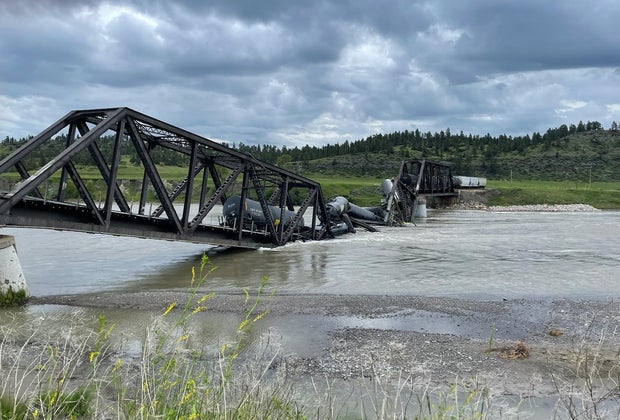
A bridge collapse early Saturday morning in Montana sent several freight train cars crashing into the Yellowstone River, authorities said. The train was carrying hazardous materials, but it remains unclear if any of those materials leaked.
The collapse occurred at about 6 a.m. local time in a section of the river between Reed Point and Columbus, according to Stillwater County Disaster and Emergency Services, which is about 60 miles west of Billings. There was no word of any injuries.
At least three of the Montana Rail Link cars which collapsed into the river contained hot asphalt, and four were carrying molten sulfur, the agency said, later adding that there was "no expected hazmat impact" to towns in the county.
In a statement, Montana Rail Link said that "both substances solidify rapidly when exposed to cooler temperatures."
The bridge collapse with the train in the river.Stillwater County DES
Montana Rail Link said that two cars which contained sodium hydrogen sulfate, an acid salt, did not enter the water, and that initial air and water tests did not find any evidence that they had leaked.
Multiple local and federal agencies were on scene, including Federal Railroad Administration officials.
Transportation Secretary Pete Buttigieg tweeted that he had spoken to Montana Gov. Greg Gianforte about the incident, and that "residents concerned about potential impacts should follow information and instructions from local authorities."
The state Fish, Wildlife and Parks department said the river would be closed, and asked boaters to avoid the area.
The public works department for the city of Billings, which borders the river, wrote on Facebook Saturday afternoon that "there is very little chance of any hazardous material getting" to the city. The department initially reported that its plan was "to shut down the water intake for the time it takes for any material to pass by Billings."
The nearby Yellowstone County Sheriff's Office initially stated in a Facebook post that several tanker cars were "leaking petroleum products near the Yellowstone River." However, Stillwater County News, a local paper, later reported that none of the freight cars were carrying oil.
Republican lawmakers in Montana are sharing that they received letters with white powder as federal agents investigate mysterious substances similarly mailed to GOP officials in two other states.
In a Friday night tweet, Republican Gov. Greg Gianforte said he has received "disturbing" reports of anonymous threats sent to legislators. The Montana attorney general posted on Facebook that the local sheriff's office collected evidence after his mother, a state representative, opened one letter with a "white powder substance" sent to her home address.
I've received disturbing reports that Montana legislators are receiving anonymous, threatening letters containing white powder. The state will bring to bear whatever resources are needed to support law enforcement officers as they investigate.
— Governor Greg Gianforte (@GovGianforte) June 24, 2023
"PLEASE BE CAUTIOUS about opening your mail," Montana Attorney General Austin Knudsen said in the post directed toward legislators. "If you receive a suspicious package, contact law enforcement immediately."
Republican officials in Tennessee and Kansas have recently received similar letters. A legislative office building in Nashville temporarily locked down on Thursday after the House Speaker said multiple Republican leaders got mail with "a white powder substance." The letters included "obvious threats made by a liberal activist specifically targeting Republicans," according to a House Republican Caucus spokesperson who did not provide further details.
The FBI said Thursday that ongoing lab tests did not indicate any risk to public safety.
About 100 such letters have been sent to lawmakers and public officials across Kansas, according to the Kansas Bureau of Investigation. Preliminary tests did not detect any common dangerous toxins and no injuries have been reported.
Thanks for reading CBS NEWS.
Create your free account or log in
for more features.
WASHINGTON (Reuters) -U.S. Special Counsel Jack Smith on Friday asked a federal judge to delay the start of former President Donald Trump's trial on charges of willful retention of classified government records and obstruction of justice until Dec. 11, a court filing showed.
On Tuesday, U.S. District Judge Aileen Cannon set an initial trial date of Aug. 14.
But Smith, in the filing, said the Aug. 14 date "would deny counsel for the defendant or the attorney for the Government the reasonable time necessary for effective preparation."
Trump, who is seeking the Republican nomination for president for the 2024 election, was arraigned in federal court in Miami last week, during which he pleaded not guilty to charges he unlawfully kept national security documents when he left office and lied to officials who sought to recover them.
The case will need to proceed under a strict and meticulous set of rules set forth in a law known as the Classified Information Procedures Act, which aims to protect classified evidence and manage how such records can be disclosed.
In the filing, Smith said the start of the trial should be delayed so Trump's lawyers have time to get security clearances to review classified documents.
Smith laid out a schedule in the lead up to the proposed Dec. 11 start of jury selection, including a Sept. 5 deadline for all defense discovery requests.
He said Trump's lawyers do not oppose scrapping the Aug. 14 trial start date but he anticipates they will file a motion opposing the prosecution's proposed schedule. A lawyer for Trump did not immediately respond to a request for comment.
(Reporting by Eric Beech; Editing by Dan Whitcomb, Sandra Maler and Jacqueline Wong)
The desperate search to find the missing Titan submersible turned into a recovery effort Thursday after officials announced that the vessel imploded sometime this week, killing all five aboard, near the Titanic shipwreck. Now authorities are turning their focus to determining why the "catastrophic implosion" happened.
Deep-sea robots will continue to search the sea floor for clues about what occured deep in the North Atlantic.
"I know there are also a lot of questions about how, why and when did this happen. Those are questions we will collect as much information as we can about now," Coast Guard rear Adm. John Mauger said, adding that it was a "complex case" that happened in a remote part of the ocean and involved people from several different countries.
The Titan, owned by undersea exploration company OceanGate Expeditions, had been chronicling the Titanic's decay and the underwater ecosystem around the sunken ocean liner in yearly voyages since 2021.
Many questions about what occurred underwater remain: Exactly when and why did the implosion occur? Will the victims' bodies ever be found? How could this tragedy have been prevented?
Here's what we do know so far:
WHEN AND WHERE DID THE TITAN GO MISSING?
The craft submerged Sunday morning, and its support vessel lost contact with it about an hour and 45 minutes later, according to the Coast Guard.
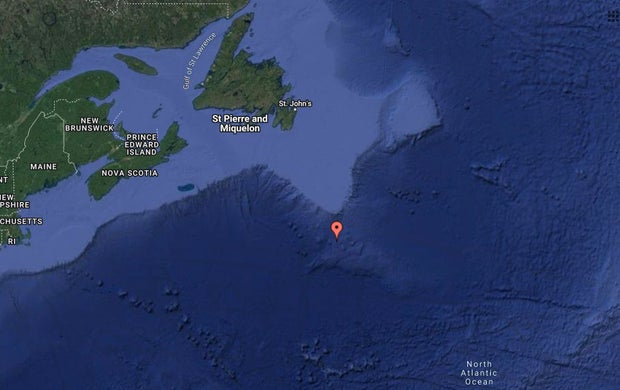
The vessel was reported overdue about 435 miles south of St. John's, Newfoundland, according to Canada's Joint Rescue Coordination Centre in Halifax, Nova Scotia.
A Google Map by NOAA shows where in the Atlantic Ocean the Titanic wreckage is located, hundreds of miles from Newfoundland, Canada. NOAA/Google Maps
The Titan was launched from an icebreaker that was hired by OceanGate and formerly operated by the Canadian Coast Guard. The ship has ferried dozens of people and the submersible craft to the North Atlantic wreck site, where the Titan has made multiple dives.
WHAT HAPPENED ABOARD THE TITAN?
The vessel suffered a catastrophic implosion, killing all five aboard, sometime this week after it submerged Sunday morning. It's not clear exactly when or where the implosion occurred. But a senior military official said Thursday that a U.S. Navy acoustic system detected an "anomaly" Sunday that was likely the Titan's fatal implosion.
The Coast Guard announced that debris from the submersible had been found and the end of rescue efforts Thursday, bringing a tragic close to a saga that included an urgent around-the-clock search and a worldwide vigil for the missing vessel.
"The debris is consistent with the catastrophic loss of the pressure chamber," Mauger said in a news conference Thursday.
A deep-sea robot discovered the debris, near the Titanic shipwreck, that authorities say came from the submersible.
A U.S. Navy official said the Navy detected "an acoustic anomaly consistent with an implosion" shortly after the sub, named Titan, lost contact with the surface Sunday, CBS News national security correspondent David Martin reported. The information was relayed to the Coast Guard, which used it to narrow the radius of the search area, the official said.
Meanwhile, banging noises that were detected during the week were assessed to have been noise from other ships in the area, Martin reported.
WHAT'S NEXT AND WHO WAS KILLED?
The Coast Guard will continue searching near the Titanic for more clues about what happened to the Titan.
Officials say there isn't a timeframe for when they will call off the massive international search. Mauger said that the prospect of finding or recovering remains was unknown.
"This is an incredibly unforgiving environment down there on the seafloor, and the debris is consistent with a catastrophic implosion of the vessel," he said. "We'll continue to work and search the area down there."
Rescue teams will remain on scene with the underwater robots mapping the debris field, but there's no indication if or when remains will be brought to the surface.
"We're going to continue to investigate the site of the debris field and then there will be a lot of questions about how, why and when did this happen," Mauger said.
Five passengers were aboard the OceanGate Titan submersible that was lost on a dive to view the Titanic.CBS News
The victims are: Oceangate chief executive and Titan pilot Stockton Rush; two members of a prominent Pakistani family, Shahzada Dawood and his son Suleman Dawood; British adventurer Hamish Harding; and Titanic expert Paul-Henri Nargeolet.
"These men were true explorers who shared a distinct spirit of adventure, and a deep passion for exploring and protecting the world's oceans," OceanGate said in a statement. "We grieve the loss of life and joy they brought to everyone they knew."
We finally know who bailed Rep. George Santos (R-NY) out of jail—despite the beleaguered congressman claiming he’d rather go to jail than give up their names.
Court documents unsealed Thursday revealed that Santos’ father and aunt put up the $500,000 bail bond that allowed Santos to walk free after his arrest by federal authorities last month.
While only their signatures appeared on the unsealed document, a source close to the matter confirmed their names as Gercino dos Santos Jr. and Elma Santos Preven.
Gercino dos Santos Jr., Santos’ father, lives in New York and previously worked as a house painter, according to The New York Times.
Santos’ father and aunt both donated thousands to his congressional bid, according to federal elections data. Preven’s social media accounts reflect a particular interest in Brazilian politics, as she has posted material critical of the country’s left-wing President Ignacio Luiz Inacio Lula da Silva and supportive of his far-right foe and predecessor, Jair Bolsonaro. A United States Postal Service worker, she owns properties in both Queens and in Brazil.
"My family & I have made peace with the judges decision to release their names,” Santos tweeted on Thursday afternoon. “Now I pray that the judge is correct and no harm comes to them.”
Prosecutors have accused Santos of running a scheme to defraud political donors, cheating the federal government out of COVID-19 relief funds, and even faking disclosure forms during his campaign for a Long Island congressional seat. The Justice Department indicted him in May on 13 counts that include money laundering, stealing public money, wire fraud, and making false statements to Congress. Santos pleaded not guilty to all those charges, calling the case a “witch hunt.”
“I’m going to fight my battle, I’m going to deliver, I’m going to fight the witch hunt, I’m going to take care of clearing my name, and I look forward to doing that,” he told reporters massed outside the court last month.
Santos surrendered to authorities at a Long Island courthouse on May 10. His suretors—the people who bailed Santos out of jail that day—stepped in to cover his $500,000 bond, but not before Santos’ defense team moved to have their identities redacted from public court filings.
Since then, Santos and his lawyers have fought tooth and nail to keep those names out of the public eye, citing perceived threats to their physical safety and emotional well-being.
“There is little doubt that the suretors will suffer some unnecessary form of retaliation if their identities and employment are revealed,” attorney Joseph Murray wrote in a June 5 letter to Judge Anne Y. Shields. He added that Santos would rather have the parties withdraw their support and await his trial in jail “than subject these suretors to what will inevitably come.”
In that same letter, Murray claimed that one of Santos’ suretors backed out after witnessing the “media frenzy” around the case.
The identity of Santos’ mystery benefactors drew the interest not only of the news media but also the House Ethics Committee, which wants to evaluate whether receiving the bail bond breached congressional rules on receiving gifts.
Media outlets had asked Judge Shields to unseal the names of Santos’ benefactors, to which she agreed in a June 6 order. Santos immediately appealed. When that move failed this week, Judge Joanna Seybert slated the reveal for Thursday at noon.
In the unsuccessful appeal, Murray countered claims that Santos violated House ethics rules by revealing that the bail money came, at least in part, from members of Santos’ family.
Santos first gained notoriety when a New York Times investigation revealed that he had lied his way into office, fabricating practically his entire resume. Since then, most of his life story—from his religious background to his mother’s death to his volleyball skills—has been exposed as fraudulent.
Santos has faced a cascade of public scandals. State and local entities, as well as authorities in Brazil, have pursued criminal probes against him. Democrats in Congress have pushed for his expulsion, while Republican Speaker of the House Kevin McCarthy has declined to support his re-election bid.
“I think he has other things to focus on in his life than running for re-election,” McCarthy told reporters in the Capitol.
But Santos hasn’t wavered on his plans to run again for New York’s 3rd congressional district in 2024, even as his legal troubles pile up.
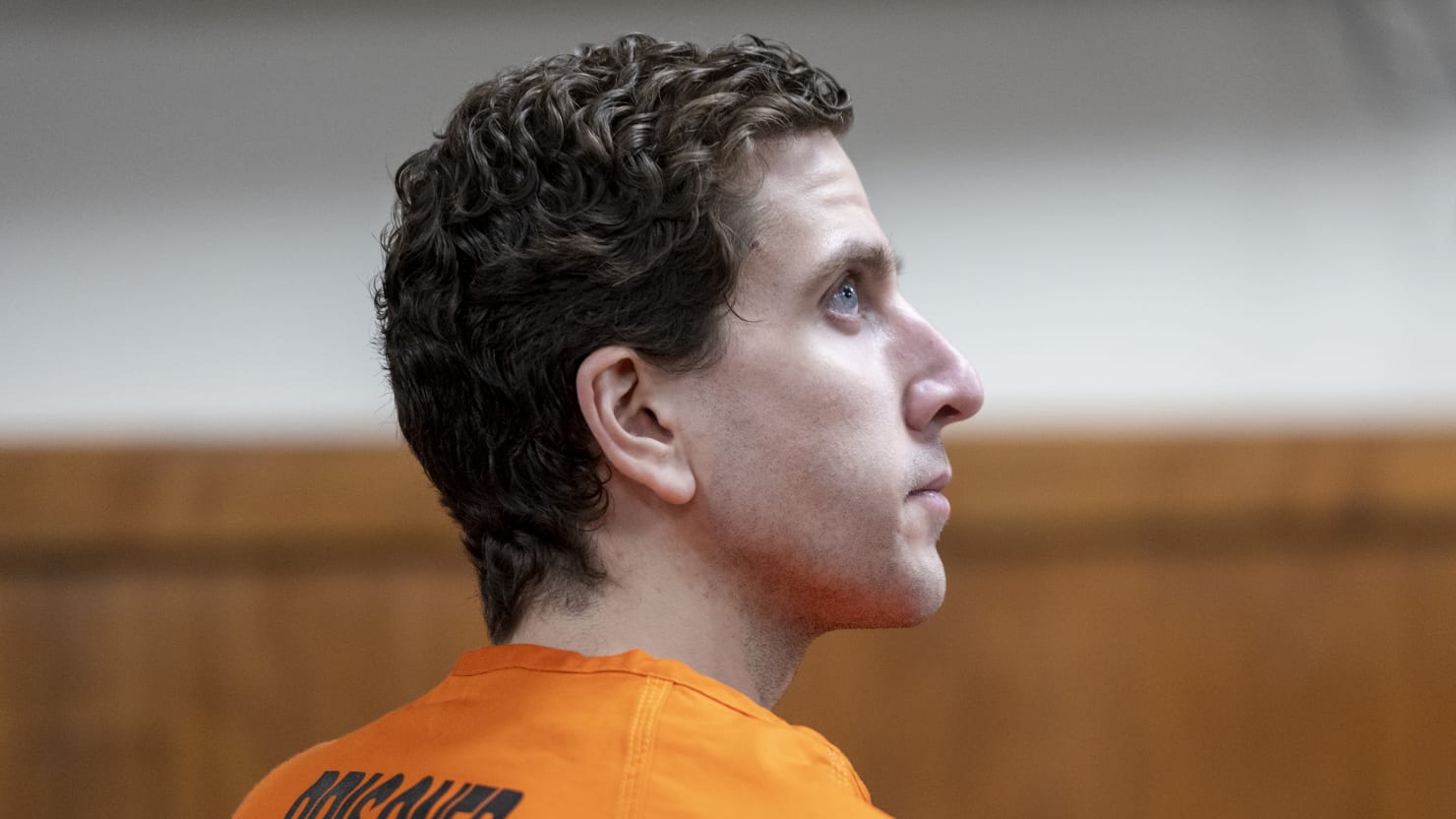
The DNA collected from a knife sheath found at the scene of the quadruple murder of four University of Idaho students last fall is a “statistical match” to accused killer Bryan Kohberger, prosecutors say.
In a June 16 motion for a protective order, Idaho prosecutors revealed that a “STR” DNA comparison was performed between a cheek swab collected from 28-year-old Kohberger and the sheath found “face down and partially under” one of the four murder victims. The DNA was “at least 5.37 octillion times more likely” to belong to Kohberger than an “unrelated individually randomly selected from the general population,” prosecutors said.
The motion seeks to protect some of the investigation, including raw DNA data, lab notes, the names and personal information of Kohberger’s relatives, and names that were matched against the DNA from genealogy services. The DNA link is the latest development in the closely watched case, and provides new details into how investigators used genetic genealogy to identify Kohberger as their prime suspect.
Prosecutors allege that Kohberger murdered Kaylee Goncalves, Ethan Chapin, Xana Kernodle, and Madison Mogen as they slept in their off-campus home in Moscow at around 4 a.m. on Nov. 13. The former doctoral criminology student at Washington State University has pleaded not guilty to several charges and is scheduled to face trial in October.
The motion says that when authorities arrived at the scene, “the sheath was face down and partially under both Madison’s body and the comforter on the bed.” Initially, the Idaho State Lab concluded that DNA found on the sheath came from a male, but the FBI was not able to directly tie it to any data in publicly available genealogy sites.
“The FBI went to work building family trees of the genetic relatives to the suspect DNA left at the crime scene in an attempt to identify the contributor of the unknown DNA,” the motion states, adding that a break in the case came when a tip was sent in to investigate Kohberger.
The tip, the motion states, did not provide “law enforcement with substantive evidence of guilt” but did prompt them to collect a DNA sample from trash recovered from Kohberger’s Pennsylvania family home. Ultimately, investigators also took a buccal swab from the suspect. That evidence was then sent to the Idaho State Lab for testing, which prosecutors say yielded a match with the sheath.