Senin, 03 Oktober 2022

GOP challenges to Biden's student loan forgiveness plan put debt relief in jeopardy - CNBC

The tens of millions of Americans who've been celebrating news of student loan forgiveness are now stuck in limbo as Republicans mount legal challenges to the Biden administration's plan.

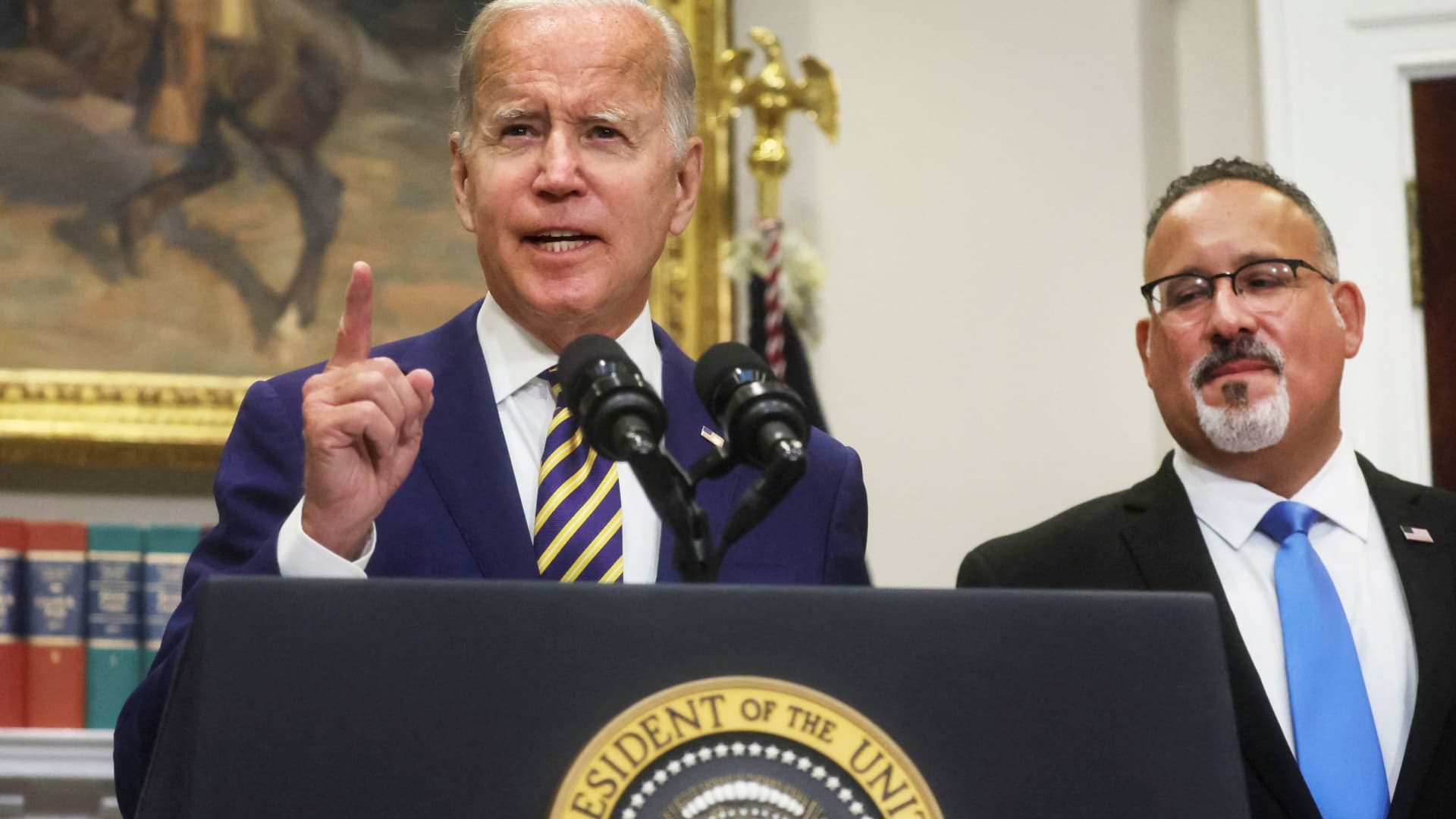
In August, President Joe Biden announced that most federal student loan borrowers will be eligible for some forgiveness: up to $10,000 if they didn't receive a Pell Grant, which is a type of aid available to low-income undergraduate students, and up to $20,000 if they did.

The White House has said that borrowers will be able to start applying for the relief this month, and could see their lowered or eliminated balances within six weeks.

More form Personal Finance:
Inflation and higher rates are a 'dangerous mix'
How persistent high inflation may affect your tax bracket
These steps can help you tackle stressful credit card debt

However, those plans may now be in jeopardy. Here's what borrowers need to know.

At least three challenges have been filed so far

On Sept. 27,  Frank Garrison, an attorney working for a conservative legal group, brought the first legal challenge to Biden's plan, arguing that forgiveness would cause him personal injury in the form of a state tax bill.

Canceled student debt can be considered taxable income. Although borrowers won't be required to pay federal taxes on their canceled student debt, thanks to a Covid pandemic-era relief provision in the the American Rescue Plan of 2021, some states — including Indiana, where Garrison resides — may charge levies on the relief.

Currently, Garrison is pursuing a government program that leads to tax-free debt cancellation, known as Public Service Loan Forgiveness, but he says Biden's plan could now cause him to get a $1,000 state tax bill.

Two days later, on Sept. 29, six Republican-led states — Arkansas, Iowa, Kansas, Missouri, Nebraska and South Carolina — filed a lawsuit to block Biden's action. The GOP state officials argue that the president doesn't have the power to issue nationwide debt relief without Congress. They're also claiming that the policy would harm private companies that service some federal student loans by reducing their business.

On the same day, Arizona Attorney General Mark Brnovich brought his own legal challenge to stop the Biden administration's plan. Brnovich asserts that the policy would reduce the impact of the Public Service Loan Forgiveness program, which he says enables his office to recruit legal talent.

The PSLF program allows those who work for the government to get their debt discharged after a decade. If borrowers' loans are simply discharged now, Brnovich argues, they'll have less of an incentive to work for the state office. Lawyers in private practice tend to get paid more.

'There is little merit in their challenge'

The main obstacle for those hoping to bring a legal challenge against Biden's plan has been finding a plaintiff who can prove they've been harmed by the policy. "Such injury is needed to establish what courts call 'standing,'" said Laurence Tribe, a Harvard law professor.

Tribe isn't convinced the current lawsuits filed have successfully done that.

"They keep looking for different ways to establish standing, and that's all well and good, but in the end, it is the merits that matter, and there is little merit in their challenge," Tribe said.

Higher education and legal expert Mark Kantrowitz said it was possible a judge may overlook an imperfect case of standing, however, because of the larger questions at play here, including the scope of the president's power.

"The president's student loan forgiveness plan will likely be overturned if it reaches the U.S. Supreme Court," Kantrowitz said.

Legal action could delay forgiveness

Valentinrussanov | E+ | Getty Images

Whether or not these challenges are ultimately successful, they're likely to slow down the forgiveness timeline.

With a federal judge deciding whether or not to grant GOP-led states' request to block Biden's plan, the administration already has said it will not cancel any student debt before Oct. 17.

The policy could be "tied up in the courts for months," Kantrowitz said.

Court battles could extend payment pause

If the battle over student loan forgiveness drags on, the Biden administration may decide to extend the pause on monthly payments yet again, Kantrowitz said.

Currently the bills, which have been on hold since March 2020, are scheduled to resume in January. But it may be too messy to turn them back on while it's still uncertain what people owe because forgiveness remains up in the air.

For now, borrowers should stay up to date with developments. You can sign up on the Education Department's website for news about the process, including when the forgiveness application will be live.

Ideally, you'll be ready to request relief as soon as the form launches, experts say. If you get your loans forgiven before a lawsuit possibly gets in the way, you might get to keep it, Kantrowitz said, "even if the courts rule against the Biden administration."

Adblock test (Why?)


from U.S. - Latest - Google News https://ift.tt/cIf7bTe
via IFTTT

Tillerson, Ex-Secretary of State, Expected to Testify in Foreign Influence Trial - The New York Times

Prosecutors are calling on him to testify in the case of Thomas Barrack, who is accused of acting as an agent for the United Arab Emirates during the Trump administration.

Rex Tillerson, the former Exxon Mobil chief executive who served as former President Donald J. Trump’s first secretary of state, is expected to testify on Monday in the trial of one of Mr. Trump’s closest allies.

Prosecutors are calling Mr. Tillerson as a witness in the case of Thomas J. Barrack Jr., a private-equity investor accused of acting as an illegal agent of the United Arab Emirates while seeking to influence the Trump campaign and administration on behalf of the Emiratis.

The testimony sets up a reunion in federal court in Brooklyn of influential figures from Mr. Trump’s early days in office. Mr. Barrack was a vocal supporter of Mr. Trump’s presidential candidacy, served as the chairman of his inaugural committee and helped guide his transition into office; Mr. Tillerson was Mr. Trump’s secretary of state and clashed with the president often until he was fired, via Twitter, in March 2018.

Mr. Tillerson’s appearance was signaled in a court filing over the weekend. Lawyers for Mr. Barrack asked that his testimony be moved from Tuesday to Monday, because Tuesday’s court day will be shortened by the Yom Kippur holiday.

Jurors in Mr. Barrack’s trial — which began with opening statements on Sept. 21 — have so far heard expert testimony about the United Arab Emirates, an oil-producing state in the Persian Gulf, and have been read hundreds of emails and text messages exchanged among Mr. Barrack, Emirati officials and Trump campaign officials in the lead-up to the 2016 presidential election.

Prosecutors have said that Mr. Barrack sought to advance the Gulf nation’s interests in the United States at the direction of Emirati officials; evidence so far shows a frenzy of correspondence about media appearances and policy positions. Mr. Barrack’s lawyers have called the accusations “ridiculous” and have said he was acting on his own accord, not as a secret agent.

Jefferson Siegel for The New York Times

Mr. Tillerson would be the first witness who could offer a firsthand account of the early days of Mr. Trump’s administration, including the impact of Mr. Barrack’s efforts.

During his brief and tumultuous tenure as the secretary of state, Mr. Tillerson was often at odds with the president over a range of issues, including Middle East policy. When the State Department blamed the intransigence of Saudi Arabia for an embargo of Qatar, Mr. Trump heaped praise on Saudi’s monarchs; while Mr. Tillerson sought to remain in the Iran nuclear deal, Mr. Trump publicly disparaged the deal.

Both Mr. Barrack and Mr. Tillerson have extensive ties overseas. Mr. Tillerson’s selection as secretary of state in 2016 was met with skepticism over his connections in Russia and other energy-producing states, including with Middle Eastern leaders, formed over his decades as a deal maker in the private sector.

Mr. Barrack is one of several people in Mr. Trump’s orbit, including some who served in his administration, who came under legal or ethical scrutiny for their connections overseas.

Prosecutors have accused Mr. Barrack of using his sway with Mr. Trump to advance the interests of the Emiratis, serving as a secret back channel for communications without disclosing his efforts to the attorney general, as the government contends he should have.

U.S. law requires anybody “operating under the control of foreign governments or foreign officials,” other than diplomats, to notify the U.S. attorney general. Mr. Barrack faces a charge that the Justice Department has described as “espionage lite,” because it typically involves “espionage-like or clandestine behavior.”

He faces nine counts in all, including counts of acting as an unregistered agent of a foreign government, obstruction of justice and making false statements. Prosecutors say Mr. Barrack repeatedly lied to Federal Bureau of Investigation agents when questioned in 2019 about his dealings with the Emiratis.

He is on trial alongside his former assistant, Matthew Grimes, who was charged only on the lobbying counts. Both were arrested in July 2021. A third defendant, Rashid al-Malik, an Emirati businessman who left the United States in 2018 after federal agents interviewed him, remains at large, prosecutors said.

Adblock test (Why?)


from U.S. - Latest - Google News https://ift.tt/SzLXQMU
via IFTTT

Minggu, 02 Oktober 2022

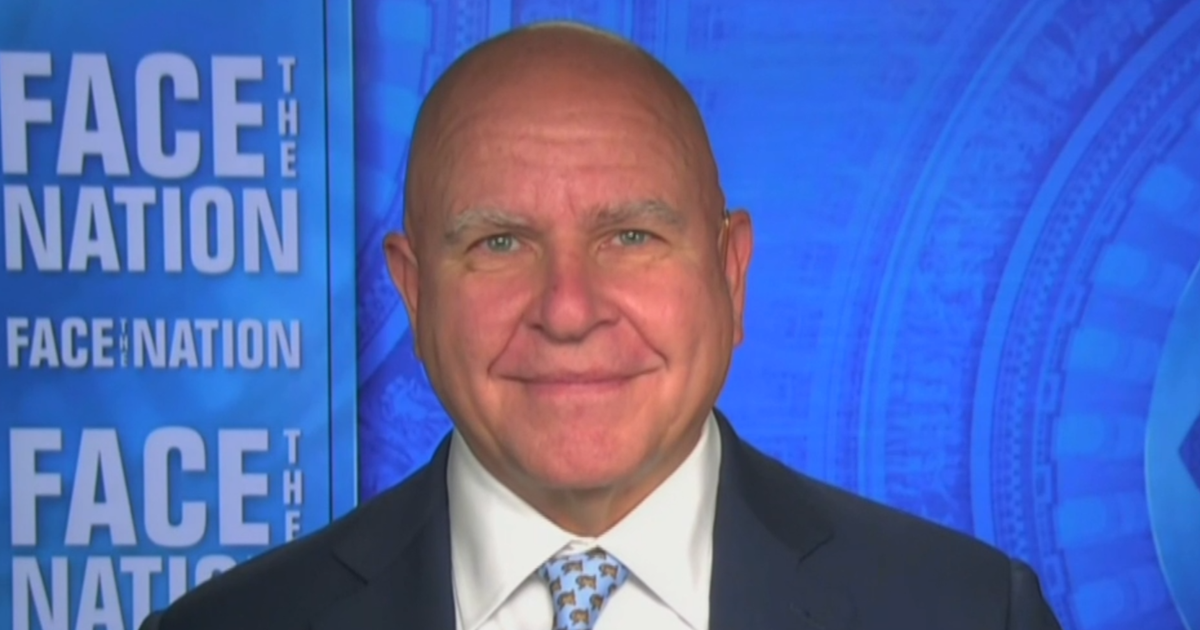
Transcript: H.R. McMaster on "Face the Nation," Oct. 2, 2022 - CBS News

The following is a transcript of an interview with retired Lt. Gen. H.R. McMaster, former national security adviser in the Trump White House and a CBS News contributor, that aired on Sunday, Oct. 2, 2022.


MARGARET BRENNAN: The Trump administration national security adviser in 2017, retired Lieutenant General H.R. McMaster, who joins us. H.R., thank you for updating us on what's happening on the ground in Ukraine with the Russian invasion. I want to get your reaction to what Defense Secretary Austin called a significant development on the battlefield in the past 48 hours. What do you see happening, and what do you forecast is Vladimir Putin's next move?

LT. GENERAL H.R. MCMASTER: Hey, good morning, Margaret. It's great to be with you. Well, this is a tremendous victory for- for the Ukrainians. And it's a victory that I think that they could turn into a cascading series of defeats of Russian forces. This is the- the encirclement of Lyman and the- and the Russian forces pulling back, but also, in the last two days, the Ukrainians also simultaneously defeated a Russian- a Russian counterattack and also made progress further in the south near the strategically important city of Kherson. And I think, Margaret, what we might be at here is really at the precipice of- of really the collapse of the Russian army in Ukraine, a moral collapse. And- and I think they must really be at a breaking point. If you look at just the numbers of casualties, the vast area that they're trying to defend, and now, of course, Russia is trying to mobilize conscripts and send them to- to the front untrained. And I think it's very important to- to also understand that these forces that are in full retreat now out of Lyman were really the first round of mobilization. Remember when Putin was trying to recruit more and more people with paying about three-times the- the average wages to get so-called volunteers to go forward. Those forces were hastily trained, thrown into that front, and these are the forces that are collapsing just right right now.

MARGARET BRENNAN: Well, and as that happens on the battlefield, rhetorically you hear President Putin raise the volume, again dangling that nuclear threat on Friday, and there was another Russian leader who talked about using low yield nuclear weapons. It's not clear what NATO or the U.S. response would be if Russia used a nuclear tactical weapon on the battlefield in Ukraine. What do you think it should be?

LT. GENERAL H.R. MCMASTER: Well, I think the message to him is if you use a nuclear weapon, it's a suicide weapon. And- and the response from NATO and the United States doesn't have to be nuclear. First of all, I would say, Margaret, he's under extreme pressure. I mean, you- you have the failures on the battlefield, which we talked about, but also the mobilization is failing. I mean, what he's done is he's mobilized almost 300,000 people to leave the country. These are- these are men who were fleeing to neighboring countries to- to escape this- this conscription. And you have the Russian people now saying, okay, I thought this was a special military operation that Putin said, hey just leave this to me, don't worry about it. Now, he's going to them to bail him out with this- with this mobilization, and what you're seeing among the hypernationalist group of- of bloggers and- and- and even on state media, is a blaming of the military. And what the military is going back to Putin is saying, hey, it's not our fault. We just need more troops. So, it's this cycle that he's responding to with the only quiver he has left, which is to, you know, to- to- to threaten the use of a nuclear weapon. But, I'll tell you, Margaret, I don't think a nuclear weapon is usable there, you know. So, I think that we ought to take it seriously. We have to, but we ought to not allow this to cow us in terms of the support for the Ukrainians.

MARGARET BRENNAN: Right. Well, the other weapon he has is energy, of course, and tracking this potential sabotage on the gas pipeline. I want to also ask you about- when you were in office back in 2017, which is the first time that the US gave off- offensive weapons to Ukraine, I remember when you were put in that position of having to explain a conversation then-President Trump had with Russian officials in the Oval Office, where he mentioned classified information. And you- you called it wholly appropriate at the time. Given what's going on now with this investigation into the classified material at Mar-a-Lago, were you ever uncomfortable with the former president's handling of classified information?

LT. GENERAL H.R. MCMASTER: Well, Margaret, remember, I left in February, March of 2018. But while I was there, I did not see any problems in handling of- of classified information. And, and what you're talking about really is a session in which the President did not disclose classified information, but somebody leaked it. And then it was published in the newspaper. So the classified information- I think it's important is to go back to that period, and that provision of javelins of the defensive capabilities to the Ukrainians was really important and, and the argument I made to President Trump at the time, was, hey, these people who are telling you that it's provocative to provide Ukraine with defensive capabilities, actually, what provokes Putin is weakness. And he was persuaded by that argument. And I think that argument is still relevant today. I mean, as Putin is encountering these difficulties, I think it's now time to remove some of the restrictions that we put on ourselves in terms of the support to give the Ukrainians and I'm talking about really long range surveillance capabilities, tied to long range precision strike. And, that's really what they need, I think to maintain the momentum militarily at this stage.

MARGARET BRENNAN: I have a follow up question on that, but just a button up the question I asked you, that was a no, you were never uncomfortable with the hand handling of classified information?

LT. GENERAL H.R. MCMASTER: No, you know what Margaret, there were systems in place. I don't know what happened to those systems. But- but- but I was never uncomfortable with it while I was there. But you know, that was a long time ago now.

MARGARET BRENNAN: Okay. I know when you're in office, you never like answering counterfactuals. But you're not in office, so was Vladimir Putin so committed to this invasion that he would have gone through with it no matter what?

LT. GENERAL H.R. MCMASTER: I don't think so. Think about all the support that we've given now to the Ukrainians. What if we had done that a few years ago? I think Putin may have come to the conclusion. Well, Ukraine cannot be- cannot be subsumed at an acceptable cost. And of course, he was wrong in all the assumptions that led to the invasion. And he's been proven wrong by courageous Ukrainians who are defending their sovereignty. But I think deterrence by denial for us was a failure. I mean, in many of the actions that we took, in the months before- before the invasion, almost I think inadvertently green lighted it, you know, pulling our forces out of the Black Sea, listing all the things we weren't going to do. And I think the administration has recovered from that very well. But- but I think now's the time, Margaret, to lift restrictions on the support that we're given Ukrainians so they can finish this fight on their terms. 

MARGARET BRENNAN: All right, H.R. McMaster, thank you very much for your insight today. We'll be back in a moment.

Adblock test (Why?)


from U.S. - Latest - Google News https://ift.tt/Ci0xS9o
via IFTTT

As New Term Starts, Supreme Court Is Poised to Resume Rightward Push - The New York Times

The justices return to the bench on Monday to start a term that will include major cases on affirmative action, voting and discrimination against gay couples. Several will take on questions about race.

WASHINGTON — The last Supreme Court term ended with a series of judicial bombshells in June that eliminated the right to abortion, established a right to carry guns outside the home and limited efforts to address climate change. As the justices return to the bench on Monday, there are few signs that the court’s race to the right is slowing.

The new term will feature major disputes on affirmative action, voting, religion, free speech and gay rights. And the court’s six-justice conservative supermajority seems poised to dominate the new term as it did the earlier one.

“On things that matter most,” said Irv Gornstein, the executive director of the Supreme Court Institute at Georgetown Law, “get ready for a lot of 6-3s.”

Anna Rose Layden for The New York Times
Mike Kai Chen for The New York Times

Several of the biggest cases concern race, in settings as varied as education, voting and adoptions.

They include challenges to the race-conscious admissions programs at Harvard and the University of North Carolina. As in last term’s abortion case, Dobbs v. Jackson Women’s Health Organization, longstanding precedents are at risk.

The court has repeatedly upheld affirmative-action programs meant to ensure educational diversity at colleges and universities, most recently in 2016. In an interview that year, Justice Ruth Bader Ginsburg said the issue had been permanently settled.

“I don’t expect that we’re going to see another affirmative action case,” she said, “at least in education.”

In that same interview, though, she said she feared what would happen were Donald J. Trump, then on the campaign trail, to become president.

Kayana Szymczak for The New York Times

“For the country, it could be four years,” she said. “For the court, it could be — I don’t even want to contemplate that.”

Mr. Trump went on to name three members of the Supreme Court, including Justice Amy Coney Barrett, who succeeded Justice Ginsburg after her death in 2020.

Those changes put more than 40 years of affirmative action precedents at risk, including Grutter v. Bollinger, a 2003 decision in which the Supreme Court endorsed holistic admissions programs, saying it was permissible to consider race as one factor among many to achieve educational diversity. Writing for the majority in that case, Justice Sandra Day O’Connor said she expected that “25 years from now,” the “use of racial preferences will no longer be necessary.”

The court seems poised to say that the time for change has arrived several years early in the two new cases, Students for Fair Admissions v. Harvard, No. 20-1199, and Students for Fair Admissions v. University of North Carolina, No. 21-707. They are set to be argued on Oct. 31.

The role race may play in government decision-making also figures in a voting rights case to be argued on Tuesday, Merrill v. Milligan, No. 21-1086. The case is a challenge under the Voting Rights Act to an Alabama electoral map that a lower court had said diluted the power of Black voters.

In earlier decisions, the Supreme Court effectively gutted Section 5 of the Voting Rights Act, which had required federal approval of changes to state and local voting laws in parts of the country with a history of racial discrimination, and cut back on Section 2 of the law, limiting the ability of minority groups to challenge voting restrictions. The Alabama case also concerns Section 2, but in the context of redistricting.

A challenge to the constitutionality of the Indian Child Welfare Act of 1978, which makes it hard for non-Native Americans to adopt Native children, may also turn on whether the court views those safeguards as based on race, making them vulnerable to constitutional review. The law at issue in the case, Haaland v. Brackeen, No. 21-376, was a response to a history of children being removed from their tribes and heritage; arguments will be heard on Nov. 9.

Nicole Craine for The New York Times

Kate Shaw, a professor at the Benjamin N. Cardozo School of Law, said the justices may conclude that these cases all present variations on the same question. “The court could announce a set of rules that, together, read the Constitution to allow virtually no consideration of race, regardless of the purposes or goals,” she said.

A second election case, Moore v. Harper, No. 21-1271, has the potential to reshape federal elections by amplifying the power of state legislatures to draw voting districts and set voting rules. It has not yet been scheduled for argument.

Nor has 303 Creative L.L.C. v. Elenis, No. 21-476, which will return the court to a battleground in the culture wars: whether some businesses open to the public may refuse to provide services to potential customers based on religious or other convictions.

The case concerns Lorie Smith, who owns a website design company that says it serves gay customers but intends to limit its wedding-related services to celebrations of heterosexual unions. She argues that requiring her to provide those services to gay and lesbian couples violates her right to free speech.

The court last considered the issue in 2018, when a similar dispute between a Colorado baker and a gay couple failed to yield a definitive ruling.

In the Dobbs decision, the justices in the majority disagreed about whether the logic of that ruling should require reconsideration of other landmark decisions, including one establishing a constitutional right to same-sex marriage. The new case does not squarely present that question, but the court’s ruling may provide hints about the justices’ commitment to protecting gay rights and, more generally, how fast it means to move to the right.

The court’s recent run of conservative decisions led its approval ratings to plummet. In a Gallup poll released on Thursday, 58 percent of Americans said they disapproved of the job the Supreme Court was doing, the highest rate since 2000, when Gallup first posed the question.

Public dissatisfaction has spread to the federal judiciary as a whole, with just 47 percent of Americans saying they had “a great deal” or “a fair amount” of trust in the judicial branch. That is a drop of 20 percentage points from two years ago, and the lowest since the question was first asked in 1972.

The responses were split along partisan lines, with Republicans generally approving of the work of both the Supreme Court and the federal judiciary. Still, the overall findings demonstrate that the court has moved to the right of the median voter, notably on issues like abortion, shortly after changes in the court’s membership.

In an extraordinary series of public appearances over the summer, several justices discussed whether unpopular decisions and falling approval ratings threatened the court’s legitimacy.

“The court has always decided controversial cases, and decisions always have been subject to intense criticism and that is entirely appropriate,” Chief Justice John G. Roberts Jr. said at a judicial conference in September. But he added, “I don’t understand the connection between opinions that people disagree with and the legitimacy of the court.”

Chief Justice Roberts, whose middle-ground approach in the abortion decision attracted not a single colleague’s vote, said the court’s role in the constitutional structure must be respected.

“If the court doesn’t retain its legitimate function of interpreting the Constitution, I’m not sure who would take up that mantle,” he said. “You don’t want the political branches telling you what the law is, and you don’t want public opinion to be the guide of what the appropriate decision is.”

David A. Strauss, a law professor at the University of Chicago, said the chief justice’s failed effort to broker a compromise in the abortion case presented him with an opportunity.

“The reaction to Dobbs would give the chief justice a chance to tell his conservative colleagues ‘I told you so’ — when you go too far, too fast, people will see the court as nothing more than the judicial wing of the conservative political movement,” Professor Strauss said. “But I doubt his colleagues would listen.”

Justice Elena Kagan, part of the court’s three-member liberal wing, spoke frequently over the summer, if in general terms, about ways courts can undermine their own authority.

That could happen, she said in New York in September, when it looks as if judges are “an extension of the political process or when they’re imposing their own personal preferences,” adding that the public has a right to expect “that changes in personnel don’t send the entire legal system up for grabs.”

Justice Sonia Sotomayor, another liberal, has echoed the point.

The court has near-total power to decide which cases it will hear, and it often uses that discretion to resolve disputes among lower courts. The court agreed to hear many of the major cases in the coming term despite a lack of such conflicts, an indication that the new majority is pursuing an agenda and setting the pace of change.

Lawyers who appear before the court have adjusted their arguments to this new reality.

“I think we’ve learned as litigants to go bold,” said Lisa Blatt, a lawyer with Williams & Connolly who has argued more Supreme Court cases than any other woman.

“This court isn’t insisting on baby steps,” she said. “I don’t see this court as an incremental one.”

Adblock test (Why?)


from U.S. - Latest - Google News https://ift.tt/MErPF9c
via IFTTT

Plan your next dinner party with these 10 showstopping recipes - The Washington Post

[unable to retrieve full-text content]

Plan your next dinner party with these 10 showstopping recipes  The Washington Post

from "recipes" - Google News https://ift.tt/f3uVPiO
via IFTTT

Rick Scott refuses to rebuke Trump, Marjorie Taylor Greene rhetoric - The Hill

Sen. Rick Scott (R-Fla.) on Sunday refused to rebuke violent rhetoric by former President Trump and Rep. Marjorie Taylor Greene (R-Ga.) in a heated interview with CBS’ Margaret Brennan.

During an appearance on “Face the Nation,” Brennan asked Scott, the chair of the National Republican Senatorial Committee, to respond to Trump’s racially-tinged statement on Friday in which he called Elaine Chao, the wife of Senate Minority Leader Mitch McConnell (R-Ky.), who also served as his Transportation secretary, “Coco Chow” and “China loving.”

Brennan also asked Scott whether remarks by Greene during a Trump rally Saturday, in which she suggested Democrats were killing Republicans, was dangerous.

Scott initially responded by suggesting that “what we got to do is we got to bring everybody together” before turning toward criticizing comments by Vice President Harris and saying that Trump was talking about “unbelievable spending that’s causing inflation hurting the poorest families.”

But Brennan pressed by then pointing to yet another part of Trump’s statement in which he says McConnell has a “death wish” for supporting a government funding bill that was supported by Democrats who hold the majority in the Senate.

“But what I quoted you is a phrase saying McConnell ‘has a death wish.’ He said racist things about Elaine Chao. And then, ‘they have already started the killings.’ I mean, that’s not a policy dispute, senator, the language is what I’m talking about. Isn’t that dangerous?” Brennan asked.

“I think we all have to figure out how do we start bringing people together and have a common goal to give every American the opportunity to get a great job, their kids to have an education [so] they believe they can be anything and make sure everybody lives in a safe community,” Scott responded.

McConnell and Trump’s relationship has been a rocky one since the former president was in the White House, and Trump in recent weeks has repeatedly lambasted the top Senate Republican, saying he should no longer serve as GOP leader while attacking Chao, referencing her family’s American business that also has dealings in China.

“He has a DEATH WISH,” Trump said of McConnell on Friday after he voted for a bill to fund the government through mid-December. “Must immediately seek help and advise from his China loving wife, Coco Chow!” using a term that is considered to be a racial slur.

Scott on CBS declined to say if that language brings people together.

“He look — he likes for you know, he gives people nicknames. I’m sure he has a nickname for me, alright?” he said of what Trump called Chao. “So you can ask him what he means by his nicknames… I can try my best to bring people together and I’m gonna try to bring people together.”

The day after Trump’s post, Greene traveled to Michigan to speak at a rally the former president held in support of his endorsed candidates there.

“I’m not going to mince words with you all. Democrats want Republicans dead, and they have already started the killings,” Greene said.

When Brennan told Scott that Greene’s comments we not true, Scott said he had not heard Greene’s remarks before turning to criticizing Harris for a remark she made a Democratic National Committee event on Friday when asked about the administration’s response to climate change.

“It is our lowest income communities and our communities of color that are most impacted by these extreme conditions and impacted by issues that are not of their own making,” Harris said at the event. “And so we have to address this in a way that is about giving resources based on equity.”

Scott tied Harris’s comment to the Federal Emergency Management Agency’s (FEMA) response to Hurricane Ian in his state.

“But it’s also not helpful what the vice president says, when she thinks that FEMA is going to treat people differently based on their skin color,” Scott said on CBS.

Updated 1:13 p.m.

Adblock test (Why?)


from U.S. - Latest - Google News https://ift.tt/ecxlhSM
via IFTTT

Sabtu, 01 Oktober 2022

Venezuela frees seven jailed Americans in swap for two Maduro relatives - Reuters Canada

WASHINGTON, Oct 1 (Reuters) - Venezuela on Saturday freed seven Americans, including five oil executives, in exchange for two relatives of Venezuelan President Nicolas Maduro jailed in the United States on drug convictions, U.S. officials said.

The swap included executives of Citgo Petroleum held for years, in addition to U.S. Marine veteran Matthew Heath and another U.S. citizen named Osman Khan. They were exchanged for two of Maduro's wife's nephews, who were arrested in 2015.

President Joe Biden said in a statement that the "wrongfully detained" Americans would soon be reunited with their relatives.

"Today, we celebrate that seven families will be whole once more. To all the families who are still suffering and separated from their loved ones who are wrongfully detained – know that we remain dedicated to securing their release," Biden said.

The prisoner transfer, which one U.S. official said took place at an airport in an unspecified third country, followed months of secretive talks with Maduro's socialist government, which is under strict U.S. sanctions, including on the OPEC nation's energy sector.

It came at a time when Washington is under growing pressure to do more to secure freedom for dozens of Americans held abroad. Much of the Biden administration's focus has been on Russia's detention of WNBA star Brittney Griner and another American, Paul Whelan.

Maduro's government said in a statement that as a result of talks that started in March two young Venezuelans "unjustly" held in the United States were freed, as well as a group of U.S. citizens who were subject to Venezuelan court proceedings and were released for "humanitarian reasons."

The freed Americans were all in stable health and "overjoyed to be heading home," while the two Venezuelans were en route back to the South American country, a senior Biden administration official told reporters in a telephone briefing.

'PAINFUL DECISION'

Biden approved the exchange weeks ago, making a "tough decision, a painful decision" that the release of the two Venezuelans was essential to securing the Americans' freedom. U.S. officials have previously said in private that Maduro wanted to use the detainees as bargaining chips.

The swap, which included Biden granting clemency to the two Venezuelans who U.S. authorities had dubbed the "narco nephews," has not altered Washington's policy toward Venezuela, a senior administration official said.

The Biden administration has only slightly eased Trump-era sanctions on Venezuela, saying it will consider more significant steps if Maduro returns to negotiations with the Venezuelan opposition and there is progress toward free elections.

An increased flow of Venezuelan oil to world markets could help replace some of the Russian supplies hit by international sanctions on Russia over its invasion of Ukraine, experts say.

The five employees of Houston-based Citgo, who had been detained in Venezuela in 2017, were Tomeu Vadell, Jose Luis Zambrano, Alirio Zambrano, Jorge Toledo and Jose Pereira.

Also released was Heath, a former Marine hospitalized following what his family said was a suicide attempt in June. He had been held since 2020 on terrorism charges, which he denied.

Khan was identified as a Florida man who had been arrested in January.

In return, the Unites States freed two of Venezuelan first lady Cilia Flores' nephews, Franqui Flores and Efrain Antonio Campo Flores.

The two, arrested in Haiti in 2015 in a U.S. Drug Enforcement Administration sting operation, were convicted in 2016 on U.S. charges that they tried to carry out a multimillion-dollar cocaine deal. They were each sentenced in 2017 to 18 years in prison.

The prisoner handover, the largest since Biden took office in January 2020, occurred in "a country in between Venezuela and the United States" after the men arrived in separate planes, a senior U.S. official said.

Citgo welcomed the news that the executives were free, saying in a statement it was "grateful to the leaders in Washington who helped bring about their release."

A Venezuelan court in 2020 sentenced the executives, accused of embezzlement, money laundering and conspiracy, to prison terms ranging from eight to 13 years. They and the company maintained their innocence, and the U.S. State Department called the charges "specious."

"We applaud President Biden for having the courage to make this deal and encourage him and the administration to continue building upon the momentum," said Jonathan Franks, spokesperson for the Bring our Families Home campaign, which advocates for Americans wrongfully held overseas.

At least four other Americans are still detained in Venezuela, including two former U.S. Army Special Forces members, Luke Denman and Airan Berry, who were arrested in 2020 in connection with a botched raid aimed at ousting Maduro.

Venezuela released two jailed U.S. citizens in March following a visit to Caracas by the highest-level U.S. delegation in years.

Reporting by Humeyra Pamuk and Matt Spetalnick; Aditional reporting by Daphne Psaledakis, Luc Cohen, Kanishka Singh and Gary McWilliams; Editing by Diane Craft, Jonathan Oatis and Daniel Wallis

Our Standards: The Thomson Reuters Trust Principles.

Adblock test (Why?)


from U.S. - Latest - Google News https://ift.tt/pqQjZbJ
via IFTTT

Three-quarters of Americans think Trump isn’t focusing on top US issues – poll - The Guardian

[unable to retrieve full-text content] Three-quarters of Americans think Trump isn’t focusing on top US issues – poll    The Guardian Trump’...